
GCSE Maths Tutors in London: AQA, Edexcel, OCR, Fees and Exam Preparation
Looking for a GCSE Maths tutor in London? Discover how to choose an experienced AQA, Edexcel or OCR tutor, understand Foundation versus Higher Tier, improve algebra and problem-solving skills, and plan revision before GCSE examinations. Includes tutoring fees, worked examples and a six-week learning plan.
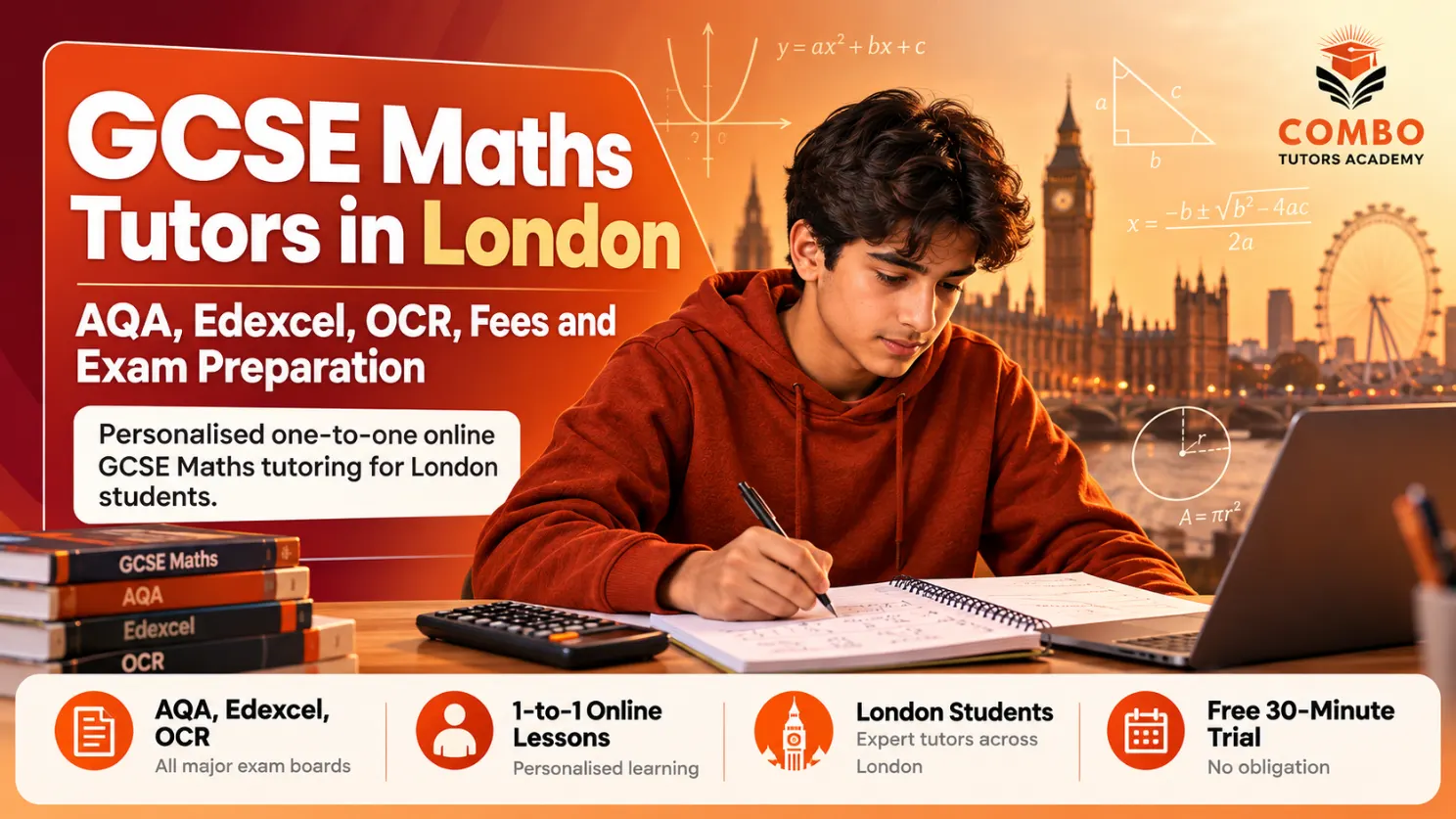
Table of Contents
Finding a GCSE Maths tutor in London can be difficult when parents are trying to improve their child's confidence before school mocks and final examinations.
Some students struggle with algebra. Others understand classroom examples but find unfamiliar problem-solving questions difficult.
A student preparing for Foundation Tier also has different assessment requirements from someone taking Higher Tier.
The best GCSE Maths tutor for your child is one who understands their examination board, Foundation or Higher pathway, current weaknesses and academic goals.
Combo Tutors Academy provides personalised one-to-one online Mathematics tutoring for GCSE students, with lessons advertised from $15 per hour on its wider Mathematics service and a free 30-minute trial.
This guide explains GCSE Maths examination boards, tier selection, effective revision methods, tuition costs and how parents can evaluate a tutor.
What Should a GCSE Maths Tutor Understand?
GCSE Mathematics involves more than teaching arithmetic and algebra.
A suitable tutor should understand the examination specification, assessment objectives and types of questions the student will encounter.
For students in England, major GCSE Mathematics examination boards include AQA, Pearson Edexcel and OCR.
Although these qualifications cover similar mathematical content, their papers and assessment materials differ.
AQA GCSE Mathematics
AQA GCSE Mathematics uses specification 8300.
It includes Foundation and Higher tiers.
Students complete three written examination papers.
Pearson Edexcel GCSE Mathematics
Pearson Edexcel GCSE Mathematics uses specification 1MA1.
Students take Foundation or Higher assessments across three papers.
OCR GCSE Mathematics
OCR GCSE Mathematics offers specification J560.
Its assessment also uses Foundation and Higher tiers.
The official Ofqual GCSE Mathematics subject-content requirements establish the common subject-content and assessment framework in England.
Students should nevertheless practise questions from their actual examination board.
Foundation vs Higher GCSE Maths: What's the Difference?
One of the first things parents should confirm is the student's examination tier.
Foundation Tier
Foundation GCSE Mathematics provides access to grades 1–5.
It covers foundational mathematical content and questions appropriate to that tier.
Higher Tier
Higher GCSE Mathematics provides access to grades 4–9, with grade 3 sometimes awarded where the relevant narrow grade boundary provisions apply.
Higher students encounter more demanding mathematical questions and content.
Which Tier Should Your Child Take?
The decision should reflect the student's current performance, school assessments and teacher recommendations.
Parents should not assume that entering Higher Tier automatically produces a better grade.
The student needs sufficient understanding to answer the more demanding questions.
1. Start With a Maths Skills Assessment
A suitable tutor should first identify why the student is losing marks.
For example, a student might score reasonably well on number questions but struggle with algebraic expressions.
Another might understand individual topics but find multi-step word problems difficult.
What Should the Tutor Review?
Recent school assessments provide useful evidence.
The tutor can also ask the student to attempt syllabus-relevant questions.
Important areas include:
- Number and arithmetic.
- Ratio and proportion.
- Algebra.
- Geometry and mensuration.
- Trigonometry.
- Probability.
- Statistics.
- Mathematical reasoning.
This helps identify weaknesses before planning regular lessons.
2. Strengthen Algebraic Foundations
Algebra is one of the most important GCSE Mathematics areas.
Students should be comfortable solving equations, simplifying expressions and using formulas.
Worked Example: Solving a Linear Equation
Solve:
3x + 7 = 22
Step 1: Subtract 7 from both sides
3x = 15
Step 2: Divide both sides by 3
x = 5
Final answer: x = 5.
Students should be able to explain why both operations preserve equality.
This foundational understanding is important for more advanced questions.
3. Practise Ratio and Percentage Questions
Ratio and percentages appear frequently in GCSE Mathematics.
Students need to interpret word problems and use proportional reasoning.
Worked Example: Ratio
Two students share £84 in the ratio 3:4.
Calculate each share.
Step 1: Add the ratio parts
3 + 4 = 7.
Step 2: Calculate one part
£84 ÷ 7 = £12.
Step 3: Calculate the shares
First student: 3 × £12 = £36.
Second student: 4 × £12 = £48.
Final answer: £36 and £48.
Always check that the two amounts add to the original total.
4. Develop Geometry and Trigonometry Skills
Geometry questions often require students to combine diagrams, formulas and reasoning.
Students should understand area, perimeter, volume and angle relationships.
Higher Tier students may also need more advanced trigonometric methods.
Worked Example: Pythagoras' Theorem
A right-angled triangle has shorter sides of 6 cm and 8 cm.
Find the hypotenuse.
Use:
Hypotenuse² = 6² + 8²
Hypotenuse² = 36 + 64
Hypotenuse² = 100
Final answer: 10 cm.
A suitable tutor should also explain when Pythagoras' theorem applies.
5. Improve Problem-Solving and Mathematical Reasoning
Some students perform well on routine questions but struggle when the question does not directly identify the required method.
This is where individual tutoring can help.
The tutor can teach students to:
- Identify what is known.
- Determine what must be calculated.
- Select a suitable method.
- Show clear working.
- Check whether the answer is reasonable.
Students should gradually attempt questions without prompts.
The aim is independent mathematical thinking.
6. Understand Calculator and Non-Calculator Practice
Students must understand the calculator rules for their actual qualification and paper.
For example, GCSE Mathematics papers may assess non-calculator work as well as calculator-supported calculations.
Students should practise mental arithmetic, fractions, percentages and algebraic methods rather than relying entirely on technology.
They also need to use permitted calculators accurately.
Revision tip: A correct calculator result does not compensate for choosing an incorrect mathematical method.
7. How Much Does GCSE Maths Tutoring Cost in London?
Online tutoring costs vary by provider, tutor experience and examination level.
Combo Tutors Academy advertises its wider online Mathematics service from $15 per hour.
Because the headline rate is in US dollars, London parents should confirm the final quotation in pounds sterling.
Specialist tutoring may be priced differently from the advertised minimum.
Illustrative Monthly Budget
Suppose a tutor charges £25 for a one-hour lesson.
Four weekly lessons cost:
4 × £25 = £100.
Eight lessons cost:
8 × £25 = £200.
These are examples rather than fixed Combo tutoring prices.
What Should Parents Check?
Confirm the hourly rate, lesson duration and cancellation arrangements.
Ask whether the student will work with the same tutor regularly.
Check whether practice questions and feedback are included.

8. What a Six-Week Tutoring Plan Could Look Like
The following example is hypothetical and illustrates a possible learning approach.
Student Situation
A Year 11 Higher Tier GCSE Maths student in London struggles with algebra and unfamiliar examination problems.
Weeks 1–2: Repair Foundations
The tutor reviews equations, algebraic manipulation and key number skills.
Weeks 3–4: Practise Application
The student completes mixed-topic questions involving algebra, graphs and geometry.
Weeks 5–6: Improve Exam Technique
Lessons focus on timed questions, reviewing mistakes and explaining mathematical methods independently.
Measuring Progress
Useful measures include accuracy on comparable questions, fewer recurring errors and school assessment results.
This is not a documented student case study or a guaranteed grade-improvement outcome.
9. GCSE Maths Tutoring Across London
Online tutoring is available to families across London.
Students in areas such as Kensington, Chelsea, Westminster, Camden, Islington, Greenwich, Croydon, Ealing and Richmond can access live online Mathematics lessons.
Parents do not need to find a tutor who lives close to their neighbourhood.
Instead, they can prioritise examination-board knowledge, lesson availability and a suitable teaching approach.
10. How to Choose a GCSE Maths Tutor in London
Before booking, parents should ask several questions.
Does the Tutor Teach the Correct Board?
Confirm AQA, Pearson Edexcel, OCR or the student's actual specification.
Does the Tutor Understand Foundation and Higher?
Lessons should be aligned with the student's tier.
Will the Tutor Assess Current Weaknesses?
Tutoring should begin with evidence of what the student finds difficult.
Is There a Trial Lesson?
A trial can help assess the student's comfort and the tutor's explanation style.
How Will Progress Be Monitored?
Look for practice questions, feedback and periodic review.
What Is the Full Cost?
Request the hourly price in pounds sterling and confirm the payment arrangements.
Common GCSE Maths Mistakes Parents Should Watch For
Repeated Algebra Errors
Students may use incorrect signs or rearrange equations improperly.
The tutor should identify the reason rather than simply correct the answer.
Missing Units
Geometry questions may require centimetres, square centimetres or cubic centimetres.
Incorrect Rounding
Students should follow examination instructions about decimal places and significant figures.
Incomplete Working
Showing relevant mathematical steps can help demonstrate the method used.
Poor Time Management
Students may spend too much time on one question and leave easier marks unanswered.
Targeted examination practice can improve how students manage their time.
Frequently Asked Questions
How Do I Find a GCSE Maths Tutor in London?
Choose a tutor experienced with the student's examination board and Foundation or Higher tier. Ask about teaching approach, pricing, progress monitoring and trial lessons.
What Is the Difference Between Foundation and Higher GCSE Maths?
Foundation offers grades 1–5. Higher ordinarily offers grades 4–9, with a limited grade 3 provision. The content and difficulty differ.
How Much Does GCSE Maths Tutoring Cost?
Prices vary by tutor and provider. Combo's wider Mathematics offering starts from $15/hour, with the confirmed sterling price depending on the recommended arrangement.
How Many Lessons Should My Child Take?
The suitable frequency depends on their current level, difficulties and examination timeline. A tutor can recommend a schedule after reviewing their needs.
Can Online GCSE Maths Tutoring Help Before Mocks?
Yes. Online tutoring can support targeted topic revision, problem-solving and timed question practice. Results depend on the student's circumstances and effort.
Final Thoughts
Effective GCSE Maths tutoring should address the reasons students lose marks.
Parents should prioritise subject knowledge, suitable tier preparation and structured progress monitoring.
A tutor who helps a student understand mathematical reasoning can provide more useful support than simply repeating textbook answers.
Find a GCSE Maths Tutor With Combo Tutors Academy
Combo Tutors Academy provides one-to-one online Mathematics tutoring for students following supported UK GCSE examination boards.
Lessons can focus on algebra, number skills, geometry, problem-solving and examination preparation.
Book a free 30-minute trial lesson to discuss your child's academic goals.
About Combo Tutors Academy
Combo Tutors Academy provides personalised online tutoring for GCSE, IGCSE, A-Level and IB students.
Families in London and elsewhere can request curriculum-specific lessons matched to learning needs.
Learn · Practice · Achieve
- Free 30-minute trial
- Tutor matched to your exam board
- Live one-to-one online lessons