
IB Chemistry Tutors in Kuwait: HL vs SL, Exams, IA and Online Tutoring
Looking for an IB Chemistry tutor in Kuwait? Understand Higher Level and Standard Level requirements, the current Structure and Reactivity syllabus, scientific investigations, examination preparation and one-to-one tutoring options for students in Kuwait City, Salmiya and surrounding areas.
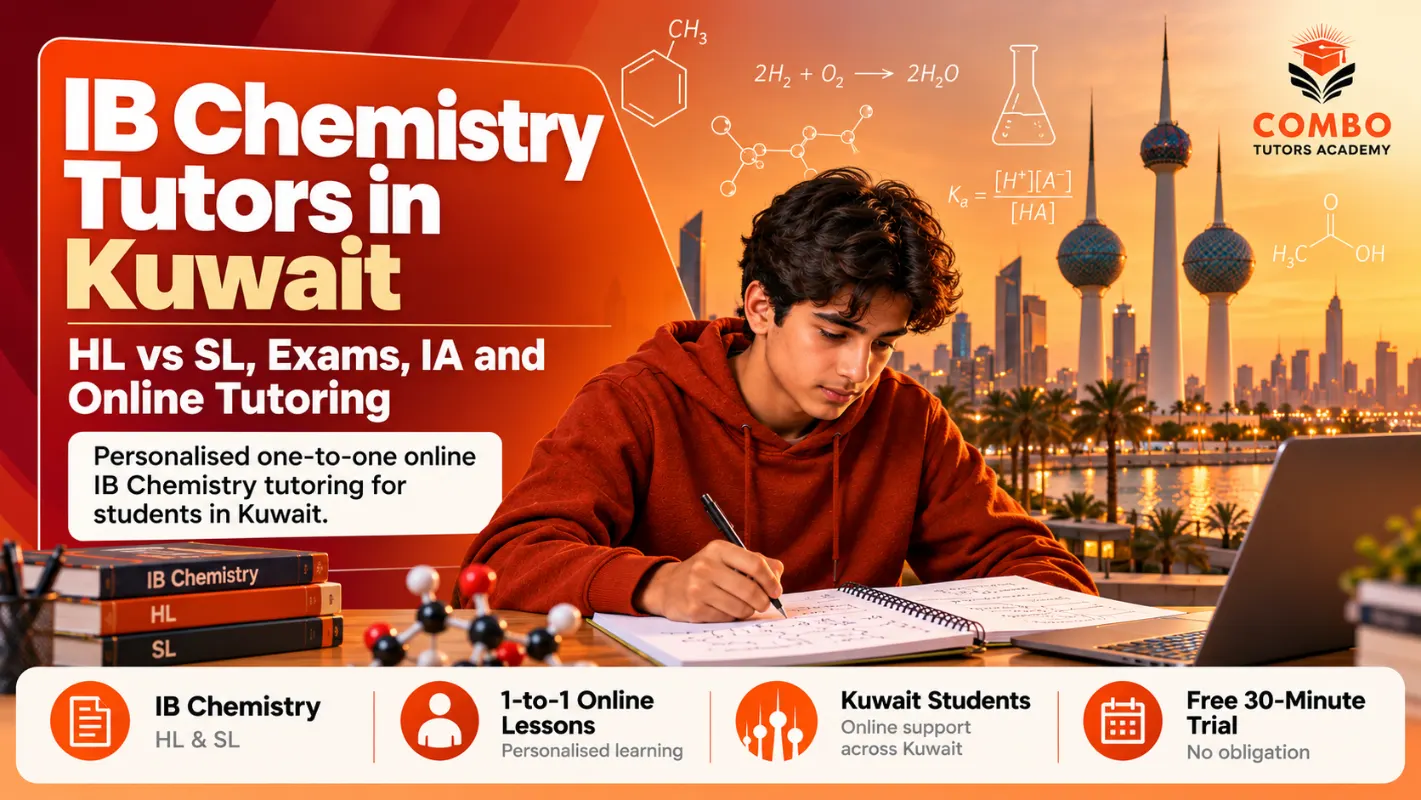
Table of Contents
Finding a suitable IB Chemistry tutor in Kuwait can be difficult when students struggle with complex scientific concepts, calculations and demanding examination questions.
An IB Chemistry Higher Level student may find organic reactions and advanced problem-solving difficult. A Standard Level student may need help understanding bonding, energetics or interpreting experimental data.
Both require preparation aligned with the actual IB Diploma Chemistry curriculum.
The best IB Chemistry tutor should understand the current syllabus, the student's HL or SL pathway, practical investigation requirements and areas of academic difficulty.
Combo Tutors Academy provides personalised one-to-one online IB tutoring for families in Kuwait, with a free 30-minute trial.
This guide explains the IB Chemistry curriculum, examination structure, internal assessment, common learning challenges and how to choose a tutor.
What Does the Current IB Chemistry Syllabus Cover?
The IB Diploma Chemistry curriculum was revised for first assessment in 2025.
The course is organised around two major concepts.
Structure
Structure explores the nature of matter and how chemical properties relate to particles and bonding.
Main areas include:
- Models of the particulate nature of matter.
- Models of bonding and structure.
- Classification of matter.
Reactivity
Reactivity explains how and why chemical changes occur.
Main areas include:
- What drives chemical reactions.
- How much, how fast and how far reactions proceed.
- Mechanisms of chemical change.
Students should connect these concepts instead of treating Chemistry as a collection of unrelated chapters.
The official IB Diploma Chemistry curriculum provides current subject information and resources.
IB Chemistry HL vs SL: What Is the Difference?
Both Standard Level and Higher Level students study the main Chemistry concepts.
However, Higher Level includes additional content and depth.
Standard Level
SL students develop scientific knowledge, quantitative skills and experimental understanding.
They need to apply chemical principles and interpret data accurately.
Higher Level
HL students study additional material and are expected to handle more demanding questions.
For example, complex reaction mechanisms and advanced quantitative reasoning may require deeper subject knowledge.
Which Level Needs More Tutoring?
The need for tutoring depends on the student's actual performance.
An SL student struggling with foundational mole calculations may need more targeted help than an HL student who is already performing confidently.
Parents should make decisions based on assessment evidence rather than course labels alone.
How Is IB Chemistry Assessed?
IB Chemistry includes external examinations and a scientific investigation.
Paper 1
Paper 1 contains two parts.
Paper 1A assesses multiple-choice questions.
Paper 1B assesses data-based questions.
Students need to interpret scientific information as well as recall knowledge.
Paper 2
Paper 2 contains short-answer and extended-response questions.
Students must apply scientific understanding, complete calculations and communicate explanations clearly.
Internal Assessment
The scientific investigation contributes 20% of the subject assessment.
The external examination components contribute the remaining 80%.
For SL, Paper 1 and Paper 2 each last 1 hour 30 minutes.
HL has longer external examinations.
Students should follow the subject guide for their examination session.
1. Strengthen Mole and Concentration Calculations
Many Chemistry problems involve amounts of substances, chemical equations and solution concentrations.
Worked Example: Solution Concentration
A student prepares 250 cm³ of a solution containing 0.050 mol of sodium chloride.
Calculate the concentration in mol/dm³.
Step 1: Convert the volume
250 cm³ = 0.250 dm³
Step 2: Use the formula
Concentration = Amount ÷ Volume
Step 3: Substitute
Concentration = 0.050 ÷ 0.250
Final answer: 0.200 mol/dm³
The key skill is understanding the relationship between quantities and using consistent units.
2. Understand Chemical Bonding and Structure
Bonding is fundamental to Chemistry.
Students should understand ionic, covalent and metallic bonding, intermolecular interactions and how structure influences properties.
For example, ionic compounds may conduct electricity when molten because their ions can move.
Students should learn to explain scientific behaviour using appropriate particle models.
Revision tip: Whenever possible, connect a substance's structure to an observable physical or chemical property.
3. Develop Confidence With Energetics
Energetics questions involve energy transfers and the reasons reactions occur.
Students should understand enthalpy changes, energy profiles and reaction feasibility.
They should distinguish between activation energy and the overall enthalpy change.
A reaction's energetics should be interpreted in the context of the question, not reduced to memorising whether it is exothermic or endothermic.
4. Improve Reaction Mechanisms
Organic reactions can be difficult because students must understand electron movement and structural changes.
Tutors should explain why a reaction occurs rather than requiring students to memorise a mechanism without understanding it.
Students can practise recognising electron-pair donors, acceptors and the bonds involved.
The exact mechanisms required depend on SL or HL content.
5. Prepare for Data-Based Chemistry Questions
Data interpretation is an important assessment skill.
Students may need to:
- Read graphs.
- Identify relationships.
- Analyse experimental trends.
- Evaluate uncertainty.
- Explain scientific conclusions.
Example
Suppose a graph shows that reaction rate increases as temperature increases.
A suitable explanation may involve the effect of temperature on molecular kinetic energy and the frequency of successful collisions, where collision theory applies.
The answer should connect the observation with scientific reasoning.
6. Understand the Chemistry Internal Assessment
The Chemistry scientific investigation is an important opportunity for students to demonstrate research and practical skills.
Students select an appropriate research question, plan an investigation, collect or analyse data and evaluate their findings.
How Can a Tutor Help?
A tutor can explain relevant scientific concepts, research methods and the published assessment expectations.
They can also provide feedback on learning and help a student understand why a method is scientifically appropriate.
However, the tutor should not fabricate experimental data, write the student's investigation or complete assessed work.
The investigation must remain the student's own.
7. How Much Does IB Chemistry Tutoring Cost in Kuwait?
IB Chemistry tutoring prices depend on level, tutor expertise and lesson frequency.
Combo Tutors Academy's main international tutoring service advertises rates from $15 per hour, with final prices dependent on the selected subject and tutor.
Kuwait families should request a quotation in KWD before booking.
Example Monthly Budget
Suppose a specialist tutor quotes KWD 10 for a one-hour lesson.
Four lessons would cost KWD 40.
Eight lessons would cost KWD 80.
These are illustrative calculations, not published Combo Kuwait rates.
Explore online tutors in Kuwait for current availability and tutoring options.
8. A Six-Week IB Chemistry Preparation Plan
Weeks 1–2: Identify Learning Gaps
Review recent school assessments.
Focus on foundational calculations, bonding and other difficult topics.
Weeks 3–4: Strengthen Application
Practise more demanding Structure and Reactivity questions.
Include data interpretation and scientific explanations.
Weeks 5–6: Improve Exam Technique
Complete timed Paper 1 and Paper 2 questions.
Review marking guidance and recurring errors.
Practise explaining the reasoning behind each answer.
9. Online IB Chemistry Tutoring Across Kuwait
Kuwait City
Families can request subject-specific online Chemistry support without travelling to a tuition centre.
Salmiya and Hawally
Students can schedule lessons around school commitments and internal assessments.
Sabah Al Salem and Fintas
Online teaching allows families to access suitable subject specialists regardless of local tutor availability.
The final timetable should be confirmed in Kuwait local time.
10. What Personalised IB Chemistry Support Could Look Like
Consider a hypothetical IB Chemistry HL student in Kuwait.
The student understands bonding but struggles with quantitative problems and reaction mechanisms.
The tutor reviews previous assessments to identify where marks are lost.
The first lessons focus on calculations and mathematical methods.
Later lessons introduce complex reaction questions and timed examination practice.
Progress is reviewed using comparable questions and the student's ability to explain chemical reasoning.
This scenario illustrates a possible tutoring process. It is not a verified Combo student case study or evidence of guaranteed results.
Frequently Asked Questions
Is IB Chemistry HL Harder Than SL?
HL includes additional content and depth. However, the difficulty experienced by an individual student depends on their strengths and prior understanding.
How Many Examination Papers Are There in IB Chemistry?
For the current course, students complete Paper 1, which includes Parts 1A and 1B, and Paper 2. The scientific investigation is assessed separately.
How Much Is the Chemistry IA Worth?
The scientific investigation contributes 20% of the final subject assessment.
Can an Online Tutor Help With IB Chemistry?
Yes. A suitable tutor can explain difficult concepts, practise examination questions and develop scientific reasoning.
Does Combo Tutors Academy Offer a Free Trial?
Yes. New students can request a free 30-minute introductory lesson.
Final Thoughts
IB Chemistry success requires conceptual understanding, quantitative accuracy and strong scientific reasoning.
Students should practise explaining why reactions occur, selecting mathematical methods and interpreting experimental evidence.
A suitable tutor should understand both the student's level and the correct assessment requirements.
Find an IB Chemistry Tutor With Combo Tutors Academy
Combo Tutors Academy offers personalised one-to-one online IB tutoring for supported subjects.
Students can receive help with Chemistry calculations, bonding, reactivity, examination technique and scientific investigation skills.
Book a free 30-minute trial lesson to discuss your child's IB Chemistry preparation.
About Combo Tutors Academy
Combo Tutors Academy is a UK-based online tutoring platform supporting IGCSE, GCSE, A-Level and IB students internationally.
Families across Kuwait and other markets can request curriculum-specific teaching.
Learn · Practice · Achieve
- Free 30-minute trial
- Tutor matched to your exam board
- Live one-to-one online lessons