
IGCSE Physics Tutors in Muscat, Oman: Cambridge 0625, Fees and Exam Preparation
Preparing for Cambridge IGCSE Physics 0625 in Muscat? Discover Core and Extended papers, formulas, practical-skills preparation and online tuition from OMR 5/hour. Includes worked examples, a six-week revision plan and guidance for parents.
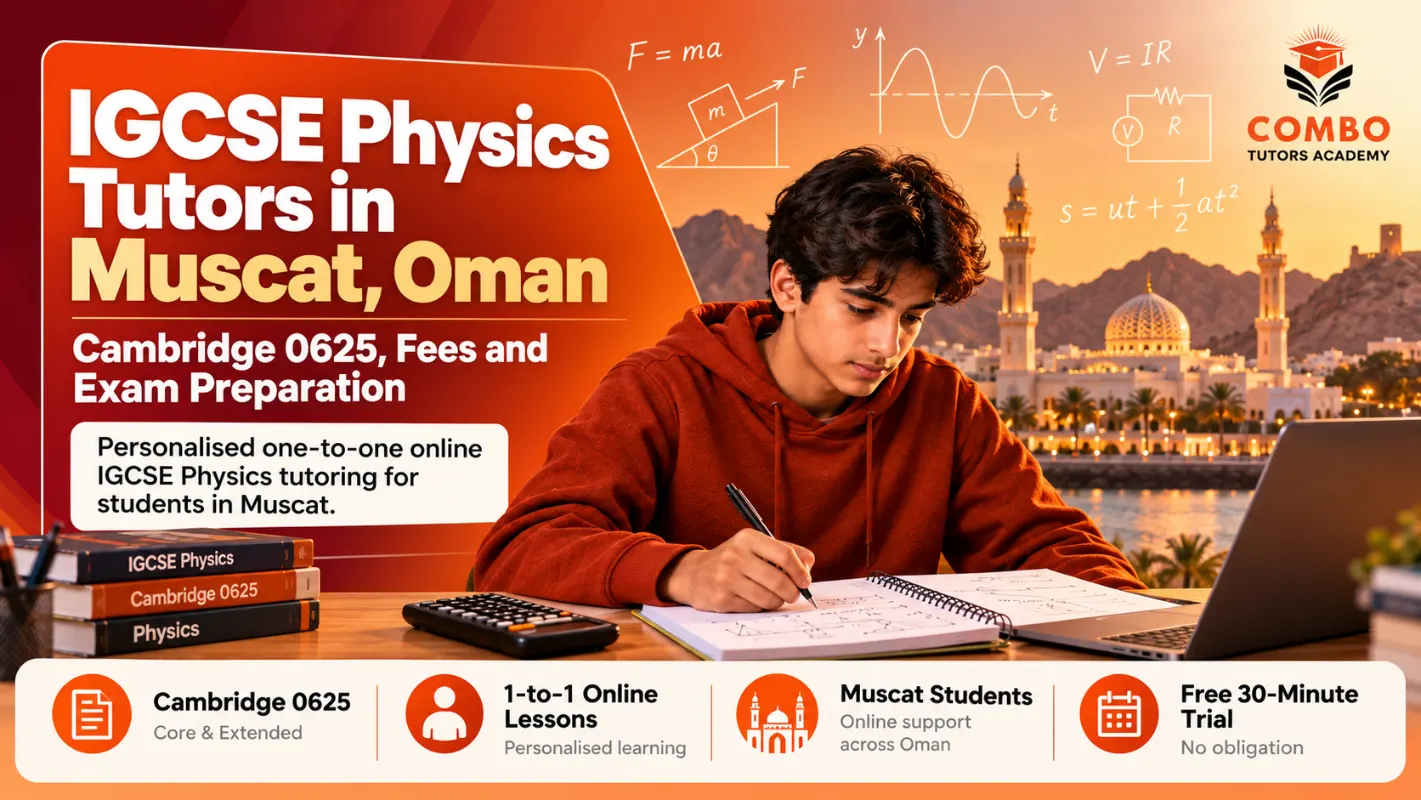
Table of Contents
Finding an experienced IGCSE Physics tutor in Muscat can be difficult when your child understands classroom explanations but struggles with calculations or unfamiliar examination questions.
A student may remember the formula for speed but choose the wrong values when solving a motion problem. Another may understand electricity theory but struggle to interpret circuit diagrams.
The most effective IGCSE Physics tutoring combines syllabus-specific explanations, accurate calculations, practical skills and regular examination questions.
Combo Tutors Academy provides personalised one-to-one online Physics tutoring for students in Muscat and across Oman, with lessons advertised from OMR 5 per hour and a free 30-minute trial.
This guide explains Cambridge IGCSE Physics 0625, its assessment pathways, important topics, tutoring costs and how to prepare effectively.
What Does Cambridge IGCSE Physics 0625 Cover?
Cambridge IGCSE Physics introduces the scientific principles used to understand motion, energy, electricity, waves and the physical universe.
For examinations in 2026–2028, the syllabus is organised into six main areas.
1. Motion, Forces and Energy
Students study speed, acceleration, forces, momentum, energy transfers and pressure.
These topics involve calculations and interpretation of graphs.
2. Thermal Physics
Students learn about particle behaviour, temperature, thermal properties and energy transfer.
3. Waves
This includes general wave properties, sound and electromagnetic waves.
4. Electricity and Magnetism
Students study electrical quantities, circuits, electrical safety and magnetic effects.
5. Nuclear Physics
This covers atomic structure, radiation and nuclear processes.
6. Space Physics
Students learn about Earth, the Solar System, stars and the wider universe.
The official Cambridge IGCSE Physics 0625 syllabus provides the current 2026–2028 specification.
Parents should select past papers and learning resources according to the student's examination year.
Cambridge IGCSE Physics Core vs Extended
Cambridge offers two assessment pathways.
Core Assessment
Core candidates take Paper 1 Multiple Choice and Paper 3 Theory, plus either Paper 5 Practical Test or Paper 6 Alternative to Practical.
The Core pathway provides access to grades C–G.
Extended Assessment
Extended candidates take Paper 2 Multiple Choice and Paper 4 Theory, plus Paper 5 or Paper 6.
Extended candidates study Core content and additional Supplement content.
The Extended pathway provides access to grades A*–G.
How Are the Papers Weighted?
Multiple choice contributes 30% of the final assessment.
Theory contributes 50%.
Practical skills contribute 20%.
Students should confirm their Core or Extended entry and practical component with their school.
1. Strengthen Physics Calculations
Many IGCSE Physics students know formulas but struggle to apply them.
The first step is recognising what each quantity represents.
Worked Example: Calculating Speed
A student observes a vehicle travelling 150 metres in 12 seconds.
Calculate its average speed.
Step 1: Identify the formula
Average speed = Total distance ÷ Total time
Step 2: Substitute
Average speed = 150 ÷ 12
Final answer: 12.5 m/s
The unit is metres per second because distance was measured in metres and time in seconds.
Common Mistake
Students sometimes use kilometres with seconds without converting units appropriately.
Always check the units before calculating.
2. Understand Forces and Newton's Laws
Forces affect the motion of objects.
Students should understand resultant force, mass and acceleration.
Newton's second law may be expressed as:
Resultant force = Mass × Acceleration
Worked Example: Resultant Force
A 4 kg object accelerates at 3 m/s².
Calculate the resultant force.
Force = 4 × 3
Final answer: 12 N
The answer is 12 newtons.
Students should understand that the formula describes the resultant force, not necessarily one individual applied force.
3. Practise Electricity Questions
Electricity can be challenging because students must interpret both mathematical relationships and circuit diagrams.
Important concepts include:
- Current
- Potential difference
- Resistance
- Series and parallel circuits
- Electrical power
- Electrical energy
Worked Example: Resistance
A component has a potential difference of 12 V across it and a current of 3 A through it.
Calculate its resistance.
Resistance = Potential difference ÷ Current
Resistance = 12 ÷ 3
Final answer: 4 Ω
Students should also understand how readings change when circuit arrangements are modified.
4. Learn to Interpret Motion Graphs
A distance–time graph provides information about how distance changes with time.
The gradient gives speed when the graph represents distance travelled against time.
A speed–time graph can provide acceleration from its gradient.
The area under an appropriate speed–time graph represents distance travelled.
Common Mistake
Students sometimes confuse the gradient with the area under the graph.
A tutor should explain the physical meaning before introducing calculations.
5. Prepare for Paper 6 Alternative to Practical
Paper 6 assesses practical understanding through written questions.
Students may need to:
- Read measuring instruments.
- Identify independent and dependent variables.
- Record data.
- Plot graphs.
- Describe methods.
- Identify sources of error.
- Suggest improvements.
For example, a question may ask why a student repeats a measurement.
Repeating readings can help identify anomalous results and assess consistency.
However, students should also understand the limitations of the method.
Revision tip: Learn the purpose of practical procedures, not just their order.
6. Use Examination Command Words Correctly
Cambridge questions use different command words.
State usually requires a concise answer.
Describe requires relevant observations or characteristics.
Explain requires scientific reasoning.
Calculate requires a numerical solution with suitable working.
Students may lose marks when they provide a definition instead of explaining a physical process.
7. How Much Does IGCSE Physics Tutoring Cost in Oman?
Combo Tutors Academy's Oman hub advertises online tutoring from OMR 5 per hour.
This is its published Oman starting rate, including international curriculum support.
The final tutoring arrangement should be confirmed before regular lessons begin.
Example Four-Week Budget
At OMR 5 for a one-hour lesson:
Four lessons cost OMR 20.
Eight lessons cost OMR 40.
Twelve lessons cost OMR 60.
These figures are illustrative calculations at the advertised starting rate, not guaranteed packages.
Visit online tutors in Oman for current tutoring information.
8. A Six-Week IGCSE Physics Revision Plan
Weeks 1–2: Strengthen Foundations
Review calculations, units, motion, forces and energy.
Use short questions to identify recurring difficulties.
Weeks 3–4: Apply Physics Concepts
Focus on electricity, waves, thermal physics and other weak syllabus areas.
Practise graphs and multi-step calculations.
Weeks 5–6: Prepare for Exams
Complete past-paper questions from the correct examination pathway.
Practise practical-style questions and timed calculations.
Record errors and revisit them.
9. IGCSE Physics Support Across Oman
Muscat and Seeb
Students can access online one-to-one Physics lessons without travelling to a tuition centre.
Sohar and Salalah
Families can request curriculum-specific support for Cambridge and other international qualifications.
Nizwa and Sur
Online lessons make it possible to work with tutors outside the student's immediate locality.
All lesson times should be confirmed in Oman local time.
10. What a Personalised Learning Plan Could Look Like
Consider a hypothetical Year 11 student in Muscat preparing for Extended Physics 0625.
The student understands basic definitions but loses marks on electricity calculations and graphs.
The tutor first reviews the student's assessment answers.
Lessons then focus on interpreting circuits, selecting formulas and explaining graph relationships.
As understanding develops, the student completes timed questions and reviews mistakes.
Progress is measured through comparable practice tasks and school feedback.
This is an illustrative learning scenario, not a documented Combo student result or guaranteed grade improvement.
Frequently Asked Questions
Can I Find Cambridge IGCSE Physics Tutors in Muscat?
Yes. Combo Tutors Academy offers online Physics tutoring for supported IGCSE qualifications. Confirm the syllabus and tutor availability before booking.
What Is the Difference Between Core and Extended Physics?
Extended includes additional syllabus content and provides access to the full A*–G grade range, while Core provides access to C–G.
Is Paper 6 Difficult?
Paper 6 requires experimental reasoning, interpreting measurements and evaluating methods. Regular practice can help students become more confident.
How Much Does Online Physics Tutoring Cost in Oman?
Combo's Oman hub advertises tutoring from OMR 5/hour. Confirm the applicable tutor and lesson arrangements directly.
Does Combo Offer a Free Trial?
Yes. New students can request a free 30-minute introductory lesson.
Final Thoughts
Successful IGCSE Physics preparation depends on understanding scientific principles and applying them to unfamiliar questions.
Students should revise calculations, explain concepts clearly and practise practical-skills questions.
A curriculum-matched tutor can help identify individual weaknesses and support more focused revision.
Find an IGCSE Physics Tutor With Combo Tutors Academy
Combo Tutors Academy provides personalised one-to-one online tutoring for students following supported Cambridge and Edexcel international qualifications.
Lessons can focus on calculations, practical reasoning, exam technique and past papers.
Book a free 30-minute trial lesson to discuss your child's Physics preparation.
About Combo Tutors Academy
Combo Tutors Academy is a UK-based online tutoring platform supporting IGCSE, GCSE, A-Level and IB students across Oman and other international markets.
Learn · Practice · Achieve
- Free 30-minute trial
- Tutor matched to your exam board
- Live one-to-one online lessons