
IGCSE Chemistry Tutors in Kuwait | Cambridge 0620
A parent-friendly guide to Cambridge IGCSE Chemistry 0620 tutoring in Kuwait, including syllabus topics, Core and Extended, practical assessments and a six-week revision plan.
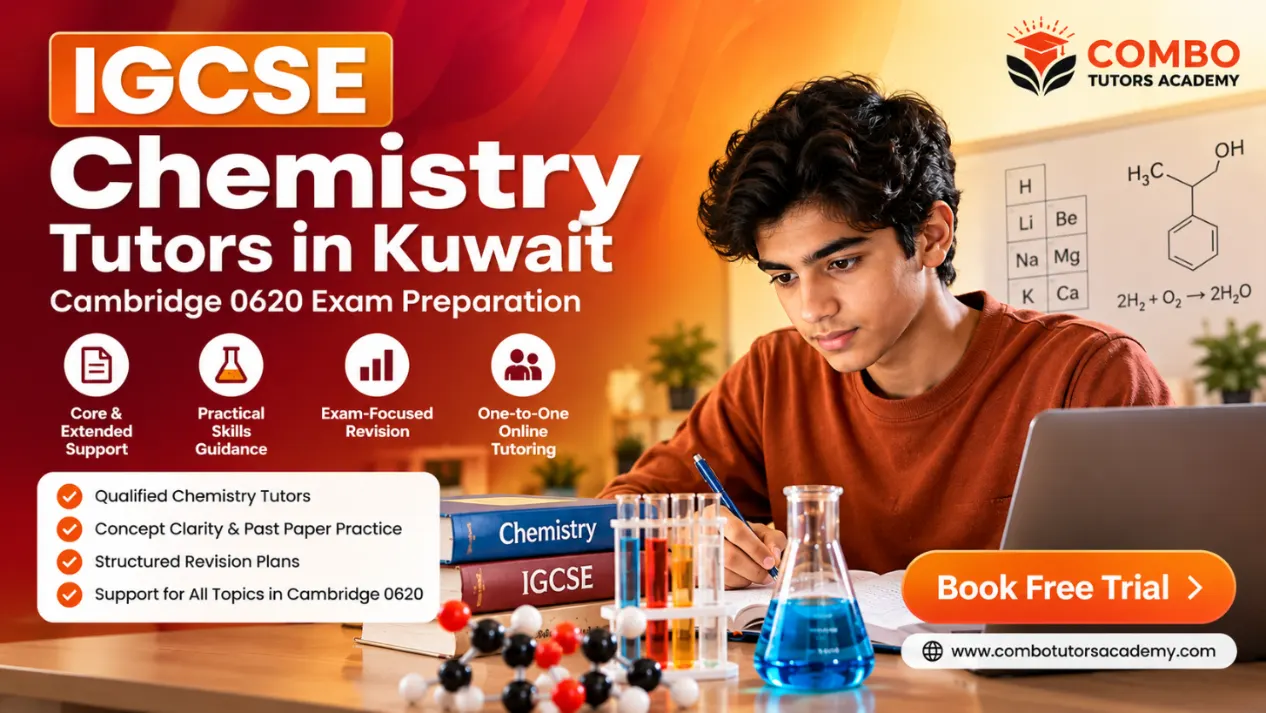
Table of Contents
IGCSE Chemistry is a demanding subject for many international school students in Kuwait. Understanding chemical reactions, balancing equations, solving mole calculations and answering practical questions requires more than memorising textbook definitions.
For students preparing for Cambridge IGCSE Chemistry 0620, the right tutor should understand the syllabus, examination structure and difference between Core and Extended assessment.
At Combo Tutors Academy, we provide online one-to-one IGCSE Chemistry tutoring for students in Kuwait, including Hawally, Salmiya, Kuwait City and surrounding areas.
Our lessons focus on understanding Chemistry, improving examination technique and building confidence through structured practice.
Why Students in Kuwait Need IGCSE Chemistry Support
Chemistry combines theory, calculations and experimental understanding.
Students may perform well in classroom exercises but struggle when examination questions combine several concepts.
Common difficulties include:
- Writing balanced chemical equations
- Calculating relative formula mass and moles
- Understanding ionic and covalent bonding
- Explaining electrolysis
- Predicting chemical reactions
- Interpreting experimental observations
- Answering longer structured questions
A specialist tutor can identify which concepts need attention and create a revision plan based on the student's current performance.
Cambridge IGCSE Chemistry 0620: Core vs Extended
Cambridge Chemistry 0620 offers two assessment routes.
- Syllabus coverage — Core: Core content
- Syllabus coverage — Extended: Core plus Supplement content
- Available grades — Core: C–G
- Available grades — Extended: A*–E
- Multiple-choice paper — Core: Paper 1
- Multiple-choice paper — Extended: Paper 2
- Theory paper — Core: Paper 3
- Theory paper — Extended: Paper 4
- Practical assessment — Core: Paper 5 or 6
- Practical assessment — Extended: Paper 5 or 6
The correct route depends on the student's school entry and target grade.
Students aiming for the highest grades need to prepare for Extended content and questions.
Parents should confirm the examination entry with the school before selecting revision resources.
Important Cambridge IGCSE Chemistry Topics
1. Atomic Structure and the Periodic Table
Students need to understand protons, neutrons, electrons, electronic configuration and periodic trends.
These concepts form the foundation for chemical bonding and reactions.
2. Chemical Bonding
The syllabus covers ionic, covalent and metallic bonding.
Students should be able to explain how bonding affects properties such as melting point, electrical conductivity and solubility.
3. Stoichiometry and Mole Calculations
Mole calculations are a common source of difficulty.
Students should practise:
- Relative atomic and formula masses
- Reacting masses
- Empirical and molecular formulae
- Concentration calculations
- Gas volumes
- Percentage yield and purity where required
The goal is to understand the relationships between quantities rather than memorise a single calculation pattern.
4. Acids, Bases and Salts
Students need to recognise different reaction types, understand pH and explain methods of salt preparation.
5. Electrolysis
Students should understand the movement of ions and predict products at electrodes under the relevant conditions.
6. Organic Chemistry
Students study important organic compounds, reaction patterns and the relationships between structures and properties.
How Cambridge Chemistry Practical Assessment Works
Cambridge Chemistry 0620 includes practical-skills assessment.
Students take either Paper 5, the Practical Test, or Paper 6, Alternative to Practical, depending on the examination entry.
Practical preparation should include:
- Identifying laboratory apparatus
- Planning investigations
- Recording observations
- Interpreting tables and graphs
- Understanding qualitative analysis
- Recognising experimental limitations
- Suggesting improvements
Students taking Paper 6 still need to understand how experiments work.
The official Cambridge IGCSE Chemistry 0620 syllabus provides the requirements for examinations in 2026–2028.
Six-Week IGCSE Chemistry Revision Plan
- Week 1 — Focus: Atomic structure and bonding
- Week 1 — Practice: Concept questions
- Week 2 — Focus: Stoichiometry
- Week 2 — Practice: Mole calculations
- Week 3 — Focus: Acids, salts and electrolysis
- Week 3 — Practice: Structured questions
- Week 4 — Focus: Energetics, rates and organic Chemistry
- Week 4 — Practice: Topic-based past papers
- Week 5 — Focus: Practical skills
- Week 5 — Practice: Paper 5/6 questions
- Week 6 — Focus: Full examination preparation
- Week 6 — Practice: Timed papers and error review
This is a sample plan. Students with larger learning gaps may need more time.
How Much Does IGCSE Chemistry Tutoring Cost in Kuwait?
Tutoring fees vary according to tutor qualifications, lesson duration, provider and frequency.
Parents should ask whether the quoted fee includes:
- One-to-one teaching
- Cambridge 0620 examination preparation
- Topic-based worksheets
- Past-paper practice
- Progress feedback
- Trial lessons
The tutor's experience with the correct examination board is more important than choosing solely by price.
Why Choose Combo Tutors Academy?
Combo Tutors Academy offers online subject tutoring designed around each student's curriculum.
For IGCSE Chemistry, lessons can include concept explanations, guided calculations, past-paper questions and regular feedback.
Families in Kuwait can arrange online lessons without travelling to a tuition centre.
Students needing support in other international qualifications can also explore our IB tutoring programmes.
Frequently Asked Questions
Is Cambridge IGCSE Chemistry 0620 difficult?
It can be challenging because it combines theory, mathematical calculations and practical reasoning. Consistent practice helps students develop these skills.
What is the difference between Core and Extended Chemistry?
Extended includes additional content and gives access to higher grades, while Core covers the foundational syllabus.
Can online tutoring help with Chemistry practical questions?
Yes. Tutors can explain experimental methods, observations, graphs and practical examination techniques. This complements, rather than replaces, hands-on school laboratory experience.
When should students begin past-paper practice?
Topic-based past papers are useful throughout the course. Full timed papers become more valuable after sufficient syllabus coverage.
Can students in Kuwait book online Chemistry lessons?
Yes. Online lessons allow students to receive individual support regardless of their area within Kuwait.
Book an IGCSE Chemistry Trial Lesson
If your child needs help with Cambridge 0620 Chemistry, Combo Tutors Academy can provide online tutoring focused on their examination requirements.
Book a free trial lesson and share your child's examination year, Core or Extended route and current difficulties.
- Free 30-minute trial
- Tutor matched to your exam board
- Live one-to-one online lessons