
IGCSE ICT Tutors in Muscat | Cambridge 0417 Online Tuition
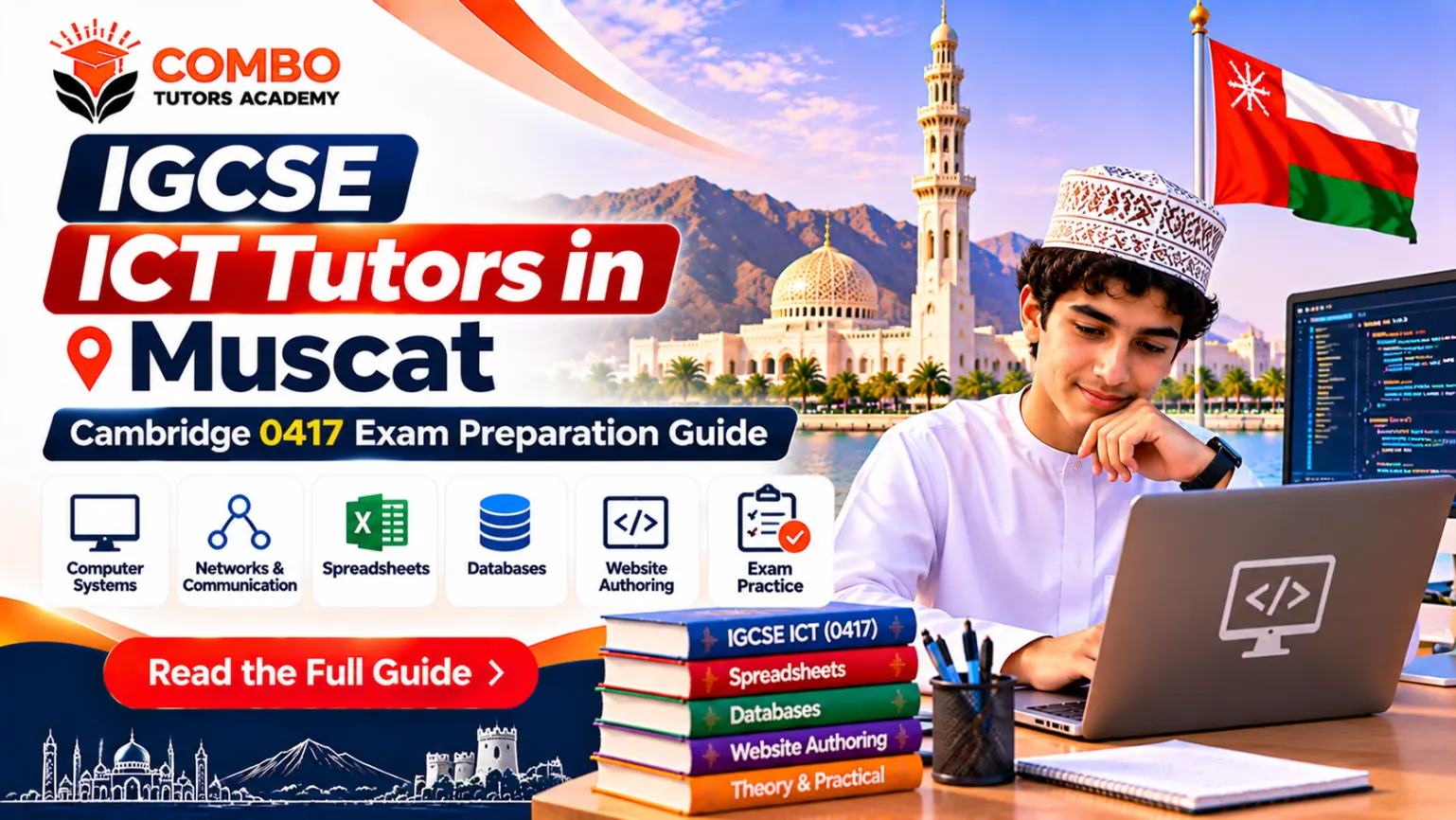
Table of Contents
Cambridge IGCSE ICT 0417 at a Glance
- Qualification — Details: Cambridge IGCSE ICT
- Syllabus code — Details: 0417
- Assessment — Details: Theory and two practical papers
- Core skills — Details: ICT knowledge, document production, spreadsheets, databases and web authoring
- Tutoring — Details: Online one-to-one lessons
- Oman tutoring rate — Details: OMR 5/hour
- Locations — Details: Muscat, Seeb, Qurum, Al Khuwair, Azaiba and surrounding areas
Students should use the official syllabus for their examination year.
What Does Cambridge IGCSE ICT 0417 Cover?
The syllabus includes theoretical knowledge and practical applications of ICT.
Types and Components of Computer Systems
Students learn about hardware, software, input and output devices, storage technologies and operating systems.
They should understand why particular devices or technologies are appropriate for different situations.
For example, choosing a suitable storage solution requires considering capacity, speed, portability, reliability and cost.
Networks and Communication
Students study computer networks, internet technologies and communication methods.
Important areas include:
- Local and wide area networks.
- Wired and wireless communication.
- Network devices.
- Internet services.
- Electronic communication.
- Security and privacy considerations.
Exam questions may require students to recommend a suitable technology for a business or educational institution.
ICT Applications
Students explore how ICT supports different organisations and activities.
Examples include banking, education, healthcare, retail and business administration.
Strong answers explain both benefits and limitations in context.
Systems Life Cycle
The systems life cycle involves analysing requirements, designing solutions, developing systems, testing, implementation and evaluation.
Students should understand why each stage matters.
Safety and Security
Students need to distinguish physical safety risks from data-security threats.
Topics include malware, unauthorised access, passwords, backups and safe working practices.
Cambridge ICT Practical Skills
Practical preparation is especially important because students must produce accurate digital outputs.
Document Production
Students may need to:
- Apply consistent styles.
- Format paragraphs and tables.
- Set page layouts.
- Insert headers and footers.
- Work with images.
- Produce documents matching detailed instructions.
A common mistake is manually formatting each heading instead of applying the requested styles consistently.
Spreadsheets
Spreadsheet tasks can involve:
- Relative and absolute cell references.
- Formulas and functions.
- Sorting and filtering.
- Data validation.
- Charts.
- Formatting.
- Printing specified ranges.
Students should understand why a formula works, not simply memorise a sequence of clicks.
Example: If a spreadsheet calculates the total cost of products, the formula may need to multiply quantity by unit price and account for any discount.
The exact formula depends on the worksheet structure.
Databases
Database tasks may require students to:
- Import data.
- Set field types.
- Define validation rules.
- Create queries.
- Sort records.
- Produce reports.
- Select relevant fields.
Students often lose marks through incorrect field selection or criteria.
Website Authoring
Website tasks can include HTML structure, CSS styling, links, images and layout requirements.
Students should practise working with source code and checking the rendered output.
Cambridge IGCSE ICT Examination Structure
The qualification has three externally assessed papers.
- Paper 1 — Assessment: Theory
- Paper 1 — Weight: 40%
- Paper 2 — Assessment: Document Production, Databases and Presentations
- Paper 2 — Weight: 30%
- Paper 3 — Assessment: Spreadsheets and Website Authoring
- Paper 3 — Weight: 30%
Paper 1 lasts 1 hour 30 minutes. Papers 2 and 3 each last 2 hours 15 minutes.
The practical components require students to demonstrate skills using appropriate software.
Official syllabus information: Cambridge IGCSE ICT 0417.
Five Common IGCSE ICT Exam Mistakes
1. Ignoring Small Formatting Instructions
Practical marking can depend on details such as font sizes, spacing, alignment and margins.
Students should check every instruction before submitting their work.
2. Incorrect Spreadsheet References
A formula may work in one cell but fail when copied because an absolute reference was required.
Students should practise recognising when to use $ in spreadsheet references.
3. Using the Wrong Database Criteria
A query can produce an incorrect result if conditions are entered in the wrong fields or combined incorrectly.
4. Forgetting Evidence Requirements
Practical tasks may require screenshots, printouts or other evidence.
Students should follow the instructions for saving and presenting their work.
5. Spending Too Long on One Task
Time management is essential.
Students should practise completing full practical papers under timed conditions.
A Practical Six-Week ICT Revision Plan
- Week 1 — Main focus: Hardware, software, networks and ICT applications
- Week 2 — Main focus: Security, systems life cycle and theory questions
- Week 3 — Main focus: Document production and presentations
- Week 4 — Main focus: Database queries and reports
- Week 5 — Main focus: Spreadsheet formulas and website authoring
- Week 6 — Main focus: Timed practical papers and error correction
Students should adapt the plan to their examination session and current skill level.
How Online IGCSE ICT Tutoring Works
Online ICT lessons can use screen sharing, guided demonstrations and independent practical exercises.
A useful tutoring programme begins with identifying the student's weakest skills.
For example, a student struggling with spreadsheets may need to practise formulas and cell references before attempting complete past papers.
Another student may need more support with database queries or theory questions.
Students can explore online tutors in Oman for additional subject support.
IGCSE ICT vs IGCSE Computer Science
These qualifications are related but have different emphases.
IGCSE ICT focuses on using information and communication technologies effectively, including practical applications.
IGCSE Computer Science places greater emphasis on computational thinking, algorithms, programming and computer systems.
Students interested in programming can also read our guide to IGCSE Computer Science Tutors in Muscat — Cambridge 0478 Exam Preparation.
Frequently Asked Questions
Is Cambridge IGCSE ICT 0417 difficult?
It can be challenging because students must demonstrate both theoretical understanding and practical accuracy.
Can I prepare for the ICT practical papers online?
Yes. Online lessons can use screen sharing and supervised exercises, provided the student has access to suitable software.
How much is IGCSE ICT tutoring in Muscat?
Combo Tutors Academy advertises online tutoring in Oman at OMR 5 per hour.
Which ICT paper is the most important?
Paper 1 contributes 40% of the qualification, while Papers 2 and 3 contribute 30% each. Students should prepare for all three.
Do I need Microsoft Office for Cambridge ICT?
Students need access to suitable software capable of completing the syllabus tasks. Schools should confirm the applications and examination environment used.
Can a tutor help with spreadsheet formulas?
Yes. Tutors can explain formulas, functions, references and error checking through practical exercises.
How early should I start ICT revision?
Regular practical work throughout the course is preferable to last-minute preparation.
Start IGCSE ICT Tutoring in Muscat
Success in Cambridge ICT requires technical knowledge, practical accuracy and familiarity with examination instructions.
Students who practise consistently and review their mistakes can develop more reliable examination skills.
Explore Combo Tutors Academy's online tutoring in Oman and enquire about IGCSE ICT lessons at OMR 5/hour.
- Free 30-minute trial
- Tutor matched to your exam board
- Live one-to-one online lessons