
IB Extended Essay Guide: How to Choose a Research Question and Plan Your Essay
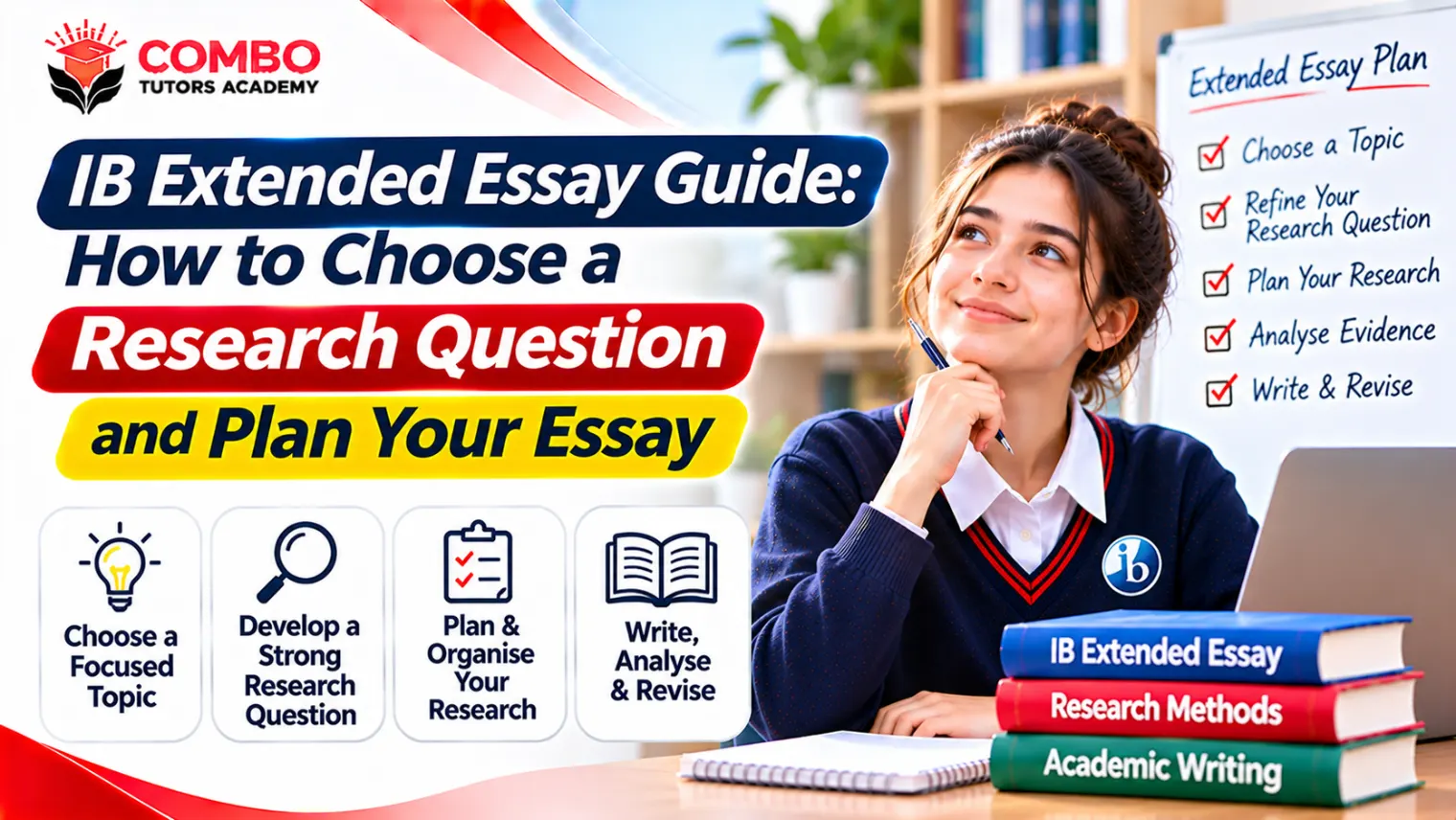
Table of Contents
**Updated: 23 November 2026 | By Combo Tutors Academy**
The International Baccalaureate Extended Essay (EE) is one of the most demanding independent assignments students complete during the Diploma Programme.
Unlike ordinary homework, the Extended Essay requires students to investigate a focused research question, examine evidence and develop a sustained academic argument.
Many students find the early stages particularly challenging. They may have several interesting topics but struggle to turn those ideas into a manageable research project.
Others begin writing before they have developed a clear research question, resulting in an essay that is too broad or descriptive.
This guide explains how to choose a suitable topic, formulate a research question, organise your investigation and manage the writing process.
What Is the IB Extended Essay?
The IB Extended Essay is an independent research assignment of up to 4,000 words completed as part of the Diploma Programme core. Students investigate a focused question through a subject-based or eligible interdisciplinary approach. Successful preparation involves selecting a manageable topic, developing a research method, evaluating evidence, constructing an argument and reflecting on the research process.
The Extended Essay is assessed externally.
Together with Theory of Knowledge (TOK), it can contribute up to three additional points towards the IB Diploma result.
Students should follow the Extended Essay guide applicable to their assessment session, particularly because an updated framework applies from the May 2027 assessment session.
Why the Research Question Matters
The research question provides direction for the entire investigation.
A broad question can make it difficult to decide which evidence is relevant.
A focused question allows the student to analyse a particular issue in sufficient depth.
For example:
Too broad: How does pollution affect the environment?
This question covers many pollutants, environments and biological processes.
More focused: How does nitrate concentration influence the growth of duckweed under controlled laboratory conditions?
The second question identifies a specific variable, organism and research context.
However, the student must still consider whether the investigation is practical, safe and appropriate for the chosen subject.
Step 1: Choose a Subject You Understand
Students should begin with a subject that genuinely interests them.
A strong Extended Essay requires sustained engagement with the research topic.
Possible subject areas include Biology, Chemistry, Physics, Mathematics, History, Economics, English and other eligible Diploma subjects.
Biology Extended Essay
Biology investigations may examine relationships involving organisms, environmental conditions or biological processes.
Students must consider ethical requirements, experimental controls and whether the necessary data can be collected.
History Extended Essay
History research may examine a particular event, decision, policy or historical interpretation.
Students should use credible primary and secondary sources and evaluate competing explanations.
Economics Extended Essay
Economics research may investigate a defined economic issue in a specific market or location.
Students should consider data availability and whether economic theory can be applied meaningfully.
English Extended Essay
Literary investigations may analyse a particular text, authorial technique or theme.
The question should encourage interpretation and argument rather than plot summary.
Step 2: Turn a Broad Topic into a Research Question
A useful research question is focused, researchable and capable of supporting analysis.
Consider three stages.
Start with an Area of Interest
For example:
Climate change and agriculture.
Identify a Specific Relationship
Narrow the topic to temperature and crop productivity.
Define the Research Scope
Choose a particular crop, location, period or dataset.
The resulting question should make clear what the investigation will examine.
Students should discuss their proposed question with their school supervisor before beginning extensive research.
Step 3: Check Whether the Question Is Researchable
An interesting question is not always a suitable Extended Essay question.
Ask:
- Can I find reliable evidence?
- Can I investigate the question within the available time?
- Is the scope narrow enough?
- Does it match the chosen subject's requirements?
- Can I analyse evidence rather than merely describe it?
- Are there ethical or safety concerns?
- Can I develop an argument supported by research?
If the answer to several of these questions is no, the topic may need further refinement.
Avoid Questions That Are Too Descriptive
A question such as “What happened during the Industrial Revolution?” encourages a general summary.
A stronger question investigates a particular cause, consequence or interpretation within a defined context.
Avoid Questions That Are Too Ambitious
Students should not select a project requiring specialist equipment, inaccessible records or extensive data collection that cannot realistically be completed.
A smaller, carefully designed investigation can support deeper analysis.
Step 4: Build a Research Plan
Before writing, create a simple research plan.
Identify the Evidence Needed
List the sources, data or experiments required to answer the question.
For a History essay, this may include contemporary documents and scholarly interpretations.
For a Science essay, it may involve experimental measurements or appropriately selected secondary data.
Evaluate Source Quality
Consider who produced the source, why it was created and whether its evidence is reliable.
A source may be relevant without being fully objective.
Record References from the Beginning
Maintain a consistent bibliography or reference list as research progresses.
Record author names, titles, publication dates, page numbers and relevant links.
This reduces the risk of missing citations during final editing.
Create a Research Schedule
Divide the project into stages:
- Topic selection.
- Research-question development.
- Preliminary reading.
- Evidence collection.
- Analysis.
- Drafting.
- Supervisor feedback.
- Revision and submission.
Use your school's internal deadlines rather than relying only on the final IB submission period.
Step 5: Understand the Extended Essay Structure
There is no single paragraph structure suitable for every subject.
However, most Extended Essays need a clear introduction, organised analysis and a conclusion.
Introduction
Introduce the research context and explain the focus of the investigation.
State the research question clearly.
The introduction should help the reader understand what is being investigated and why the question is worth examining.
Research Method or Approach
Explain how evidence was selected or collected, where appropriate.
The level of methodological detail depends on the subject.
A scientific investigation may require experimental procedures, while a literary essay may explain the analytical approach.
Main Analysis
This is the central part of the essay.
Organise the discussion around evidence and arguments that address the research question.
Each section should contribute to the investigation rather than introduce unrelated information.
Evaluation
Consider the limitations of the evidence and the strength of competing explanations.
For experimental work, discuss uncertainty and methodological limitations.
For source-based research, evaluate reliability and interpretation.
Conclusion
Answer the research question based on the evidence presented.
Avoid introducing major new arguments or unsupported claims.
A strong conclusion also recognises meaningful limitations.
References and Presentation
Follow the current IB guidance and your school's requirements for citations, bibliography, presentation and word count.
Do not assume that an older sample essay follows the latest assessment framework.
Step 6: Move from Description to Analysis
One of the most common Extended Essay problems is excessive description.
Description explains what happened or what the evidence shows.
Analysis examines why it matters and how it supports an argument.
Consider a History example.
Descriptive: The government introduced a new policy in 1950.
Analytical: The policy changed the government's relationship with a particular social group, as demonstrated by contemporary records and later historical interpretations.
The second approach requires evidence and explanation.
Students should repeatedly ask:
How does this paragraph help answer my research question?
If the connection is unclear, the material may need revision or removal.

Step 7: Manage the 4,000-Word Limit
The Extended Essay has a maximum word count of 4,000 words.
This does not mean students should aim to fill every available word with background information.
The priority is a focused argument.
Allocate Space to Analysis
Keep general background information concise.
Reserve substantial space for examining evidence, explaining reasoning and evaluating conclusions.
Avoid Repetition
Repeatedly explaining the same point does not strengthen the argument.
Each section should contribute something new.
Edit for Clarity
After completing a draft, check whether sentences can be simplified without losing meaning.
Precise academic writing is more valuable than unnecessarily complicated language.
Step 8: Use Supervisor Feedback Effectively
The Extended Essay is an independent student project, but students receive guidance from a school supervisor.
Use meetings to discuss:
- Research-question suitability.
- Scope and feasibility.
- Research challenges.
- Progress against deadlines.
- Interpretation of the assessment requirements.
- Areas requiring further independent work.
Students must follow the IB's academic-integrity and supervision requirements.
A tutor or supervisor can help students understand research methods, but the submitted investigation and writing must remain the student's own work.
Common IB Extended Essay Mistakes
Choosing an Overly Broad Question
A broad topic often produces a descriptive essay.
Better approach: Define a narrower question with clear boundaries.
Starting Without Enough Research
Students may begin writing before understanding the available evidence.
Better approach: Complete preliminary research before finalising the argument.
Ignoring Conflicting Evidence
A convincing academic argument should consider relevant alternative explanations.
Better approach: Evaluate evidence critically rather than selecting only sources that support the initial assumption.
Leaving Referencing Until the End
Missing citation details can create unnecessary difficulties.
Better approach: Maintain references throughout the project.
Treating the First Draft as the Final Version
Strong academic writing usually requires revision.
Better approach: Allow time to improve organisation, argument quality and clarity.
A Practical Eight-Week Extended Essay Work Plan
This is a planning example, not a replacement for your school's official schedule.
Week 1: Select a subject and shortlist research ideas.
Week 2: Refine the research question and discuss feasibility with the supervisor.
Week 3: Conduct preliminary research and organise sources.
Week 4: Collect or analyse the main evidence.
Week 5: Develop an argument and detailed essay outline.
Week 6: Complete the first draft.
Week 7: Review feedback and strengthen analysis.
Week 8: Check citations, presentation, word count and final submission requirements.
Some investigations require a substantially longer research period, particularly those involving experimental work.
How Parents Can Support IB Extended Essay Preparation
Parents can help students organise their time without taking over the project.
Encourage regular progress reviews and realistic milestones.
Ask whether the research question is manageable and whether the student has discussed it with their supervisor.
Provide a suitable study environment and help protect time for other IB subjects.
Avoid writing, rewriting or conducting the investigation on the student's behalf.
The Extended Essay is intended to develop independent research skills.
Can an IB Tutor Help with the Extended Essay?
A subject tutor can help students strengthen the underlying knowledge and research skills needed for independent academic work.
For example, a Biology tutor may explain experimental controls, while an Economics tutor may help a student understand relevant economic theory.
Support should focus on learning, research methods and independent reasoning.
It should not involve producing assessed work for the student.
Combo Tutors Academy provides personalised online IB subject tutoring.
Explore our IB tutoring programmes and book a free 30-minute trial lesson to discuss your academic needs.
Frequently Asked Questions
How Long Is the IB Extended Essay?
The Extended Essay is an independent research assignment with a maximum length of 4,000 words.
How Do I Choose a Good Research Question?
Choose a question that is focused, researchable and suitable for the selected subject. Make sure reliable evidence is available and that the investigation can be completed within the available time.
Can I Change My Extended Essay Research Question?
Changes may be possible during the research process, but students should discuss them with their school supervisor and consider the impact on deadlines.
Is the Extended Essay Required for the IB Diploma?
Yes. The Extended Essay is a compulsory component of the full IB Diploma Programme core.
Does the Extended Essay Affect My IB Score?
Yes. The Extended Essay and Theory of Knowledge can contribute up to three additional points to the overall Diploma score, subject to the applicable assessment rules.
Can a Tutor Write or Edit My Extended Essay?
A tutor may explain concepts and support the development of research skills, but the assessed work must remain the student's own. Students should follow IB academic-integrity requirements.
Final Thoughts
A successful IB Extended Essay begins with a focused research question and a realistic plan.
Students should select a suitable topic, investigate reliable evidence and develop an argument that directly answers their question.
Starting early, using supervisor guidance appropriately and allowing time for revision can make the research process more manageable.
For support with IB subject knowledge and independent study skills, explore Combo Tutors Academy's IB tutoring programmes and book a free trial lesson.
- Free 30-minute trial
- Tutor matched to your exam board
- Live one-to-one online lessons