Cambridge IGCSE Maths 0580: How to Prepare for the Non-Calculator Paper
Prepare for Cambridge IGCSE Maths 0580 non-calculator papers with a practical revision guide. Learn essential topics, mental maths techniques, exam strategies and a four-week study plan for Core and Extended students.
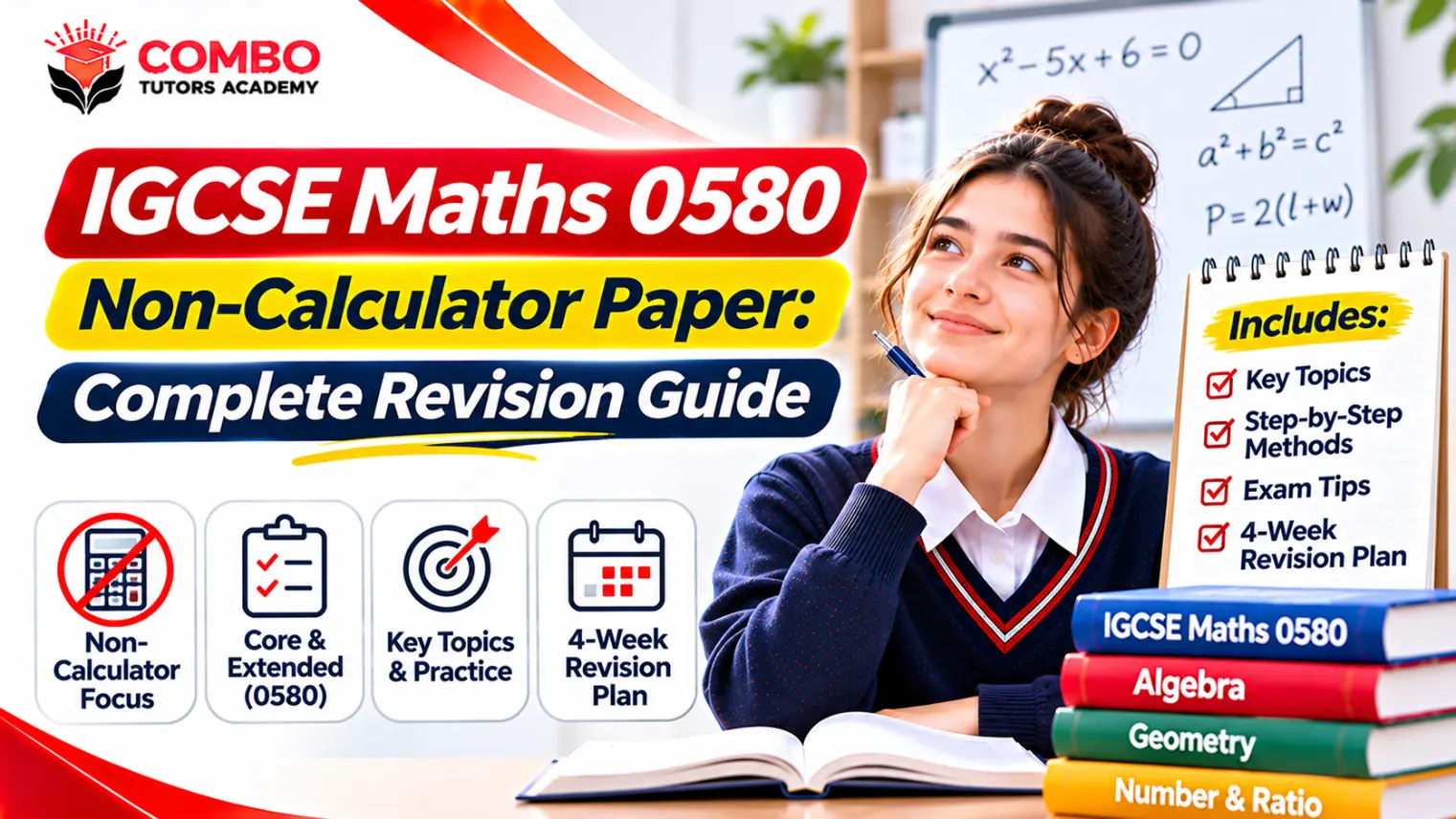
Table of Contents
**Updated: 23 November 2026 | By Combo Tutors Academy**
Preparing for Cambridge IGCSE Mathematics (0580) requires more than learning formulas. Students need to understand mathematical methods, show accurate working and solve problems both with and without a calculator.
For examinations from 2025, Cambridge introduced a dedicated non-calculator paper at both Core and Extended levels.
This change makes mental arithmetic, fraction skills, algebraic manipulation and accurate written calculations particularly important.
If you are preparing for the Cambridge IGCSE Maths non-calculator paper, this guide explains the examination structure, essential revision topics and practical ways to improve your confidence.
How Do You Prepare for the IGCSE Maths Non-Calculator Paper?
The best way to prepare is to strengthen arithmetic, fractions, percentages, algebra and written problem-solving methods. Practise questions without a calculator, learn to show clear working and use official Cambridge past papers. Start with individual topics before completing full timed papers. Review errors carefully, particularly mistakes involving negative numbers, fractions and calculation accuracy.
Understand the Cambridge IGCSE Maths 0580 Paper Structure
Cambridge IGCSE Mathematics (0580) offers Core and Extended routes.
The assessment structure for 2025–2027 includes two papers at each level.
Core Mathematics
Paper 1 — Non-Calculator
- Duration: 1 hour 30 minutes.
- Marks: 80.
- Weighting: 50%.
- Calculator: Not permitted.
Paper 3 — Calculator
- Duration: 1 hour 30 minutes.
- Marks: 80.
- Weighting: 50%.
- Calculator: Required.
Extended Mathematics
Paper 2 — Non-Calculator
- Duration: 2 hours.
- Marks: 100.
- Weighting: 50%.
- Calculator: Not permitted.
Paper 4 — Calculator
- Duration: 2 hours.
- Marks: 100.
- Weighting: 50%.
- Calculator: Required.
Both routes include mathematical reasoning and problem-solving.
The Extended route assesses additional and more demanding content.
Students should confirm their examination entry with their school and use the specification for the year in which they will sit the examination.
Why Non-Calculator Maths Feels Difficult
Many students are comfortable solving mathematical questions when they can use a calculator.
Without one, they may struggle with arithmetic, fractions, decimals and multi-step calculations.
However, the non-calculator paper is not simply a test of mental speed.
It assesses whether students understand mathematical relationships and can select appropriate methods.
For example, a student may know how to calculate a percentage using a calculator but struggle to find 15% of an amount mentally.
The solution is to build flexible calculation skills rather than memorise hundreds of isolated answers.
Topic 1: Fractions, Decimals and Percentages
Fractions and percentages are essential for both Core and Extended Mathematics.
Students should confidently:
- Simplify fractions.
- Add and subtract fractions.
- Multiply and divide fractions.
- Convert between fractions, decimals and percentages.
- Find percentages of quantities.
- Solve percentage increase and decrease problems.
Example: Finding a Percentage Without a Calculator
Calculate 15% of 240.
First, find 10%:
240 ÷ 10 = 24
Next, find 5%:
24 ÷ 2 = 12
Therefore:
15% of 240 = 24 + 12 = 36.
This method develops number sense and reduces reliance on a calculator.
Revision Tip
Practise calculating 10%, 5%, 20%, 25% and 50% of different quantities.
Then combine these values to calculate less familiar percentages.
Topic 2: Negative Numbers and Order of Operations
Errors involving negative numbers can affect many other mathematical topics.
Students should understand:
- Adding and subtracting negative numbers.
- Multiplying and dividing signed numbers.
- Using brackets correctly.
- Following the order of operations.
- Working with powers and roots.
For example:
-6 × -4 = 24
A negative multiplied by a negative gives a positive result.
However:
-6 + -4 = -10
Students should understand why these operations produce different results.
Practise a mixture of calculations rather than completing only one type of question.
Topic 3: Algebra Without a Calculator
Algebra is a major part of IGCSE Mathematics.
Students need to manipulate expressions accurately and solve equations using written methods.
Simplifying Expressions
For example:
3x + 5x - 2x = 6x
Students must recognise like terms.
Expanding Brackets
For example:
3(x + 4) = 3x + 12
Extended students should also practise more demanding algebraic manipulation according to their syllabus.
Solving Equations
Consider:
4x + 7 = 23
Subtract 7:
4x = 16
Divide by 4:
x = 4
Students should show each important stage.
Factorising
Factorisation requires recognising common factors or algebraic patterns.
For example:
6x + 12 = 6(x + 2)
The specific factorisation techniques required depend on whether the student is taking Core or Extended Mathematics.
Topic 4: Ratio and Proportion
Ratio questions frequently require students to translate words into mathematical operations.
Consider a quantity of 72 shared in the ratio 5:3.
First, find the total number of parts:
5 + 3 = 8
One part is:
72 ÷ 8 = 9
The two shares are:
5 × 9 = 45
3 × 9 = 27
Students should practise identifying the number of parts before performing calculations.
Ratio skills also support percentages, scale drawings and proportional reasoning.

Topic 5: Geometry and Mensuration
Geometry questions can combine diagrams, formulas and numerical calculations.
Important areas include:
- Angles in triangles and polygons.
- Parallel-line angle rules.
- Perimeter and area.
- Circumference and area of circles.
- Pythagoras' theorem.
- Similarity and scale.
- Trigonometry where required.
Use the Formula Sheet Correctly
Cambridge provides a formula sheet with the Mathematics 0580 examination papers from 2025 onwards.
However, students still need to understand when a formula is appropriate and which formulas are not provided.
Do not assume that the formula sheet replaces the need to learn mathematical methods.
Practise locating formulas and applying them to unfamiliar questions.
How to Improve Mental Maths Skills
Mental arithmetic becomes more reliable through short, regular practice.
Learn Useful Number Relationships
Recognise common fraction-percentage equivalents.
For example:
- 1/2 = 50%.
- 1/4 = 25%.
- 1/5 = 20%.
- 3/4 = 75%.
These relationships make percentage and proportion calculations easier.
Break Calculations into Smaller Parts
To calculate 18 × 25:
18 × 25 = 18 × 100 ÷ 4 = 450.
Flexible calculation methods can be more efficient than lengthy written multiplication.
Estimate Before Calculating
Estimation helps students identify unreasonable answers.
If a calculation involves multiplying approximately 20 by 30, an answer near 600 is expected.
A result of 6,000 should prompt a check.
How to Use Past Papers Effectively
Past papers help students understand how mathematical knowledge is assessed.
However, the best results come from analysing mistakes.
Step 1: Select the Correct Paper
Core students should practise Paper 1.
Extended students should practise Paper 2.
Use papers that match the current assessment structure wherever possible.
Older papers can provide topic practice, but their format may differ.
Step 2: Complete Questions Without a Calculator
Avoid using a calculator to check every step while practising.
Instead, complete the question independently before reviewing your answer.
Step 3: Show Clear Working
Written calculations should be organised so that each step can be followed.
This also makes it easier to identify where a mistake occurred.
Step 4: Use Official Mark Schemes
Compare your method and answer with the marking guidance.
Pay attention to the difference between a calculation error and a misunderstanding of the question.
Step 5: Reattempt Incorrect Questions
Return to mistakes after revising the relevant topic.
The goal is to demonstrate that you can now solve the problem independently.
A Four-Week IGCSE Maths Non-Calculator Revision Plan
Week 1: Strengthen Number Skills
Focus on fractions, decimals, percentages, negative numbers and arithmetic.
Complete short daily calculation exercises.
Goal: Reduce avoidable calculation errors.
Week 2: Revise Algebra and Ratio
Practise equations, expressions, factorisation and ratio problems.
Include both straightforward and multi-step questions.
Goal: Improve mathematical method selection.
Week 3: Practise Geometry and Mixed Questions
Revise geometry, measurement and other syllabus topics.
Complete mixed examination questions without being told which method to use.
Goal: Become more confident with unfamiliar problems.
Week 4: Complete Timed Papers
Complete full non-calculator papers under examination conditions.
Review mistakes and revisit weak topics.
Goal: Improve accuracy, confidence and time management.
Common Mistakes to Avoid
Using a calculator during practice: This prevents students from developing the written methods required in the examination.
Skipping working: Even when a calculation seems simple, clear working can help avoid mistakes.
Rushing arithmetic: Small numerical errors can affect an entire multi-step solution.
Ignoring word problems: Understanding the question is just as important as performing the calculation.
Only practising easy questions: Students should gradually introduce unfamiliar and more demanding problems.
When Should You Consider an IGCSE Maths Tutor?
Additional support may be useful when students repeatedly struggle with fractions, algebra, geometry or examination technique.
A tutor can identify prerequisite skills that need improvement and provide targeted practice.
Combo Tutors Academy offers personalised online IGCSE Mathematics lessons for students preparing for Cambridge examinations.
Our tutors can help with non-calculator methods, topic revision, problem-solving and past-paper practice.
Explore one-to-one IGCSE tutoring and book a free 30-minute trial lesson.
Frequently Asked Questions
Is the Cambridge IGCSE Maths 0580 Paper 2 non-calculator?
Yes. Under the 2025–2027 syllabus, Paper 2 is the Extended non-calculator paper. Core students take Paper 1 as their non-calculator paper.
How long is the IGCSE Maths non-calculator paper?
Core Paper 1 lasts 1 hour 30 minutes. Extended Paper 2 lasts 2 hours.
Is a formula sheet provided?
Yes. Cambridge provides a formula sheet in Mathematics 0580 examinations from 2025 onwards.
How can I improve my non-calculator Maths?
Practise arithmetic, fractions, percentages and algebra regularly. Use written methods, review mistakes and complete timed questions without a calculator.
Should I practise older past papers?
Older papers can be useful for topic practice, but students should prioritise papers and specimen materials matching the current assessment format.
Can online tutoring help with IGCSE Maths?
One-to-one tutoring can provide personalised explanations, targeted practice and feedback on mathematical methods.
Final Thoughts
Preparing for the Cambridge IGCSE Maths non-calculator paper requires accuracy, understanding and consistent practice.
Start with foundational number skills, strengthen algebra and geometry, and practise using official examination questions.
With a structured revision plan, students can develop greater confidence in solving mathematical problems without relying on a calculator.
Need personalised support? Explore IGCSE Maths tutoring at Combo Tutors Academy and book a free 30-minute trial lesson.
- Free 30-minute trial
- Tutor matched to your exam board
- Live one-to-one online lessons