GCSE Maths: How to Move from Grade 3 to Grade 5
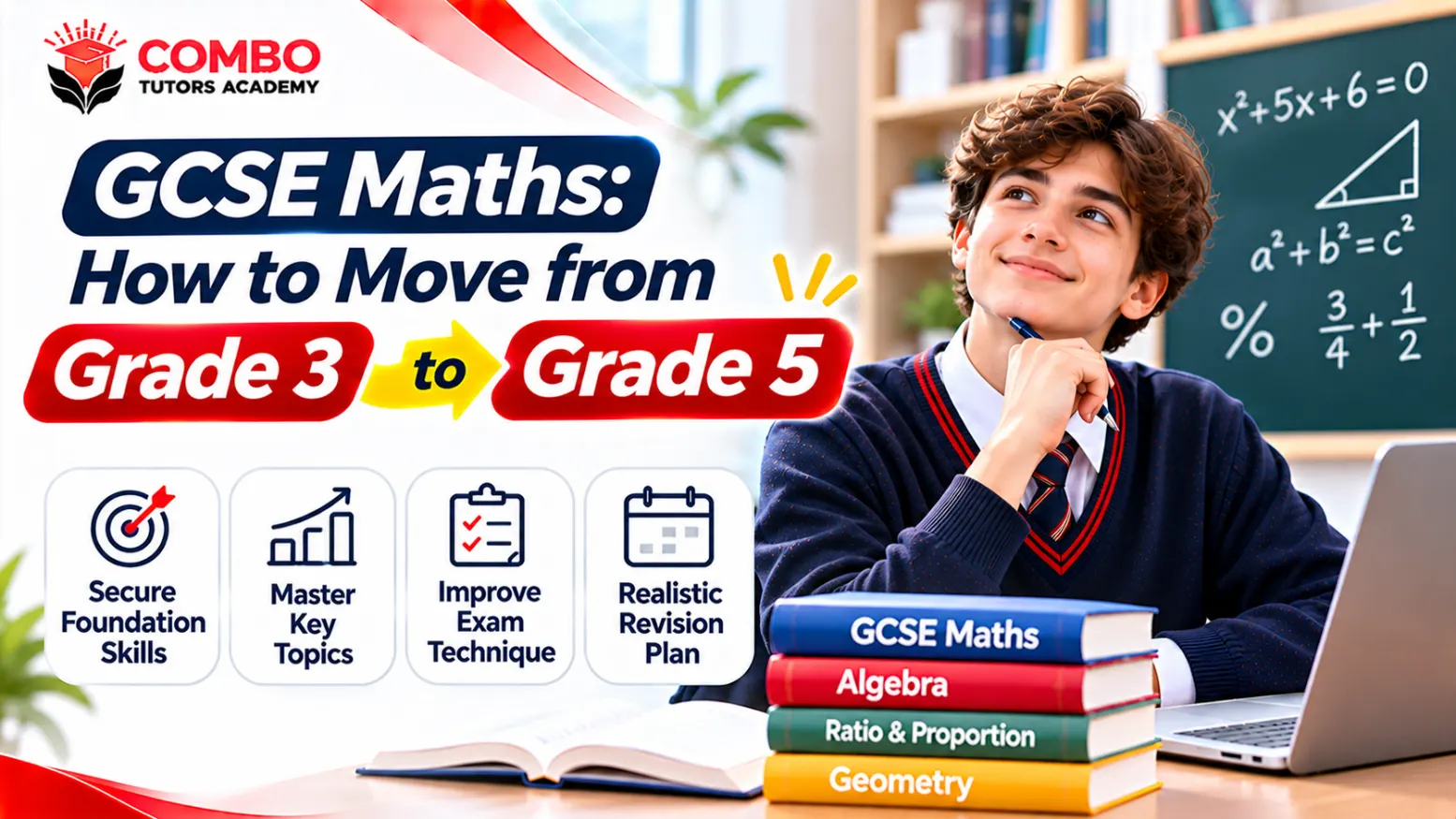
Table of Contents
**Updated: 21 November 2026 | By Combo Tutors Academy**
Your child has received a Grade 3 in GCSE Maths, but their target is Grade 5. Is that achievable before the final examinations?
For many Year 10 and Year 11 students, improving from Grade 3 to Grade 5 is a realistic goal with the right preparation. The key is understanding why marks are being lost and following a revision plan that addresses those weaknesses.
Students do not necessarily need to relearn every Mathematics topic. They need to become more consistent with foundational questions and develop confidence with the harder topics assessed on Foundation papers.
Whether your child studies Pearson Edexcel (1MA1), AQA (8300) or OCR (J560), this guide explains how to work towards a Grade 5 without unnecessary pressure.
How Can You Get a Grade 5 in GCSE Maths?
Moving from Grade 3 to Grade 5 in GCSE Maths is achievable for some students through focused Foundation-tier preparation. First, secure marks on familiar Grade 1–3 questions involving arithmetic, fractions and basic algebra. Next, practise Grade 4–5 crossover topics such as ratio, equations, Pythagoras and trigonometry. Use timed past papers, review mistakes and improve examination technique. Progress depends on the student's starting point and preparation.
The objective is to improve the proportion of available marks secured across all three papers.
Why Moving from Grade 3 to Grade 5 Matters
GCSE Maths uses a grading scale from 9 to 1, with Grade 9 being the highest.
Grade 4 is considered a standard pass, while Grade 5 is considered a strong pass.
Both grades can be important for progression into sixth form, college, apprenticeships and other post-16 opportunities.
Some courses require at least Grade 4 in Mathematics. Others specify Grade 5 or higher.
The exact requirement depends on the institution and programme.
For a student currently working at Grade 3, reaching Grade 4 can open additional options. Moving towards Grade 5 may provide more flexibility for future study.
However, the goal should not create unnecessary anxiety.
A Grade 3 often indicates that a student already understands some of the Mathematics needed for success but is not yet applying that knowledge consistently.
The next step is identifying which skills need attention.
What Does a Grade 3 in GCSE Maths Actually Mean?
A Grade 3 does not mean a student is incapable of Mathematics.
It may indicate that the student can answer straightforward questions but struggles when problems become more complex.
For example, a student might confidently calculate 20% of 150 but find it difficult to solve a multi-step percentage problem involving a discount followed by a price increase.
Another student might solve a simple equation but struggle when the unknown appears on both sides.
These weaknesses are specific and can be addressed through targeted practice.
Why GCSE Grade Boundaries Change
GCSE grade boundaries are the marks required to achieve particular grades in a given examination series.
They are set after the examinations have been marked and can change between years.
This means there is no fixed number of marks that guarantees Grade 5 every year.
A student should therefore avoid relying on an outdated target such as “you only need a certain percentage to pass.”
Instead, use past papers to identify which questions can be answered reliably and where additional marks can be gained.
The practical goal is to secure more available marks consistently, not chase a fixed percentage.
GCSE Maths Foundation vs Higher: Which Tier Is Better?
Choosing the correct examination tier is one of the most important decisions for a student currently predicted Grade 3.
Foundation Tier: Grades 1–5
Foundation tier assesses Mathematics content across Grades 1 to 5.
Grade 5 is the highest possible Foundation grade.
For many students working at Grade 3, Foundation provides a suitable route towards a standard or strong pass.
It allows revision to focus on the content needed for those grades rather than introducing the full range of more advanced Higher-tier material.
Higher Tier: Grades 4–9
Higher tier is designed primarily for Grades 4 to 9, although a Grade 3 may be awarded under specified circumstances.
It includes more demanding mathematical content.
A student currently struggling with basic algebra, fractions and multi-step problems may find Higher-tier papers unnecessarily difficult.
However, Higher is appropriate for students whose performance and potential support entry at that level.
Who Decides the Examination Tier?
Schools make entry decisions based on assessment evidence, mock results, teacher judgement and the student's likely performance.
The decision is often reviewed during Year 11.
Parents should ask:
- Which tier is my child currently expected to sit?
- What evidence supports that decision?
- What would need to improve before the entry is finalised?
- Is Grade 5 a realistic target on the proposed tier?
For a student aiming specifically for Grade 5, Foundation can be an appropriate choice. It is not automatically a disadvantage simply because Grade 5 is its ceiling.
Understand the Three GCSE Maths Papers
Students should practise using the correct examination board and tier.
Pearson Edexcel GCSE Maths (1MA1) Foundation
- Paper 1: Non-calculator, 80 marks, 1 hour 30 minutes.
- Paper 2: Calculator, 80 marks, 1 hour 30 minutes.
- Paper 3: Calculator, 80 marks, 1 hour 30 minutes.
AQA GCSE Maths (8300) Foundation
- Paper 1: Non-calculator, 80 marks, 1 hour 30 minutes.
- Paper 2: Calculator, 80 marks, 1 hour 30 minutes.
- Paper 3: Calculator, 80 marks, 1 hour 30 minutes.
OCR GCSE Maths (J560) Foundation
- Paper 1: Calculator, 100 marks, 1 hour 30 minutes.
- Paper 2: Non-calculator, 100 marks, 1 hour 30 minutes.
- Paper 3: Calculator, 100 marks, 1 hour 30 minutes.
All three papers contribute equally to the final grade within each qualification.
Students should practise the correct paper format because calculator permissions and mark totals differ between boards.
Step 1: Secure the Grade 1–3 Foundation Marks
Before concentrating on harder questions, students should become reliable at answering the foundational questions.
Foundation papers generally begin with more accessible material and progress towards more demanding problems.
The earlier sections are therefore a useful starting point, although there is no guaranteed dividing line between grades or fixed allocation of marks.
Arithmetic and Number Skills
Practise:
- Addition, subtraction, multiplication and division.
- Negative numbers.
- Order of operations.
- Factors and multiples.
- Rounding.
- Estimation.
Students should be able to complete routine calculations accurately without repeatedly checking basic methods.
Fractions, Decimals and Percentages
Focus on converting between fractions, decimals and percentages.
Practise finding fractions and percentages of amounts, comparing values and performing calculations involving fractions.
These skills also support more advanced ratio and proportion questions.
Basic Algebra
Students should confidently:
- Simplify expressions.
- Substitute values into formulas.
- Solve one-step and two-step equations.
- Expand a single bracket.
- Recognise number sequences.
A student who struggles with these skills should repair them before attempting more demanding algebraic questions.
Graphs and Tables
Practise reading coordinates, interpreting charts and extracting information from tables.
Students should also understand basic linear graphs.
A Useful Practice Method
Take a Foundation past paper and concentrate initially on its earlier questions.
Complete them under a realistic time limit.
Mark the answers and record every mistake.
Repeat this process with different papers until the student can answer most accessible questions accurately.
The first milestone is consistency. Marks lost on familiar questions make the Grade 5 target more difficult.
Step 2: Master the Grade 4–5 Crossover Topics
Once foundational skills are stronger, students can focus on the more demanding Foundation content.
These topics are sometimes called crossover topics because related material appears across Foundation and Higher assessments.
The exact question difficulty varies, so students should follow their board's specification rather than assume every question on a topic is worth the same grade.
Ratio, Proportion and Percentages
Ratio: Simplifying ratios, dividing quantities in a given ratio and solving contextual problems.
Direct proportion: Understanding how two quantities change together.
Percentages: Percentage increases, decreases and reverse percentage calculations where specified.
Best buys: Comparing prices using unit costs, such as cost per kilogram or cost per item.
For example, a student might compare two supermarket offers to determine which provides better value.
The challenge is identifying the correct calculation from the wording of the problem.
Algebra and Equations
Equations with unknowns on both sides: Solve equations such as 5x + 3 = 2x + 18.
Rearranging formulas: Make a different variable the subject of a simple formula.
Expanding double brackets: Multiply two binomial expressions.
Factorising simple quadratics: Recognise factors of expressions such as x² + 5x + 6.
Simultaneous linear equations: Solve two equations involving two unknowns.
These topics require students to apply several basic algebra skills together.
Rather than memorising isolated examples, students should practise explaining each step.
Geometry and Measures
Pythagoras' theorem: Calculate missing sides in right-angled triangles.
Trigonometry: Use sine, cosine and tangent (SOHCAHTOA) in right-angled triangles.
Angles: Solve problems involving parallel lines, polygons and angle relationships.
Area and circumference: Apply appropriate formulas to circles and other shapes.
Volume: Calculate volumes of prisms and cylinders.
Students should practise selecting the correct formula and recognising when a question requires multiple steps.
Probability and Statistics
Tree diagrams: Represent and calculate probabilities involving successive events.
Venn diagrams: Interpret overlapping sets and probability information.
Box plots: Read and compare median values, quartiles and spread.
Averages from grouped data: Calculate estimated means and interpret grouped information.
These topics often involve interpreting information before performing calculations.
Students should practise explaining what the data represents.
Number and Accuracy
Standard form: Convert between ordinary numbers and standard form and perform appropriate calculations.
Error intervals: Identify possible values when a measurement has been rounded.
Multi-step problems: Combine fractions, decimals and percentages in unfamiliar contexts.
Students should also practise estimation and checking whether an answer is reasonable.
What About Surds and Cumulative Frequency?
For this Foundation-focused revision plan, do not prioritise Higher-only material such as surd manipulation or cumulative-frequency graph questions from the Edexcel and AQA Higher specifications.
Use the current Foundation specification for the student's examination board to select the correct topics.

Step 3: Improve GCSE Maths Exam Technique
Knowing the Mathematics is only part of examination success.
Students also need to communicate their methods clearly and manage their time.
Show Your Working
Method marks may be awarded even when the final answer is incorrect.
For example, a student solving a multi-step equation should write each important stage rather than jump directly to an answer.
Clear working also makes mistakes easier to identify during revision.
Use the Number of Marks as a Guide
The mark allocation can indicate how much work a question may require.
A one-mark question may need a straightforward response.
A four-mark question may involve several steps, explanations or calculations.
This is a guide rather than a strict rule.
Attempt Every Question
Students should avoid leaving questions blank simply because they appear unfamiliar.
Write down relevant information, identify a possible method and show any useful working.
Partial progress may earn marks.
Check Whether Answers Make Sense
If a question asks for the price of three inexpensive items, an answer of several thousand pounds should prompt a second look.
Estimation helps identify arithmetic mistakes.
Prepare for Calculator and Non-Calculator Papers
On non-calculator papers, students need confidence with arithmetic, fractions and mental methods.
On calculator papers, they must enter calculations correctly and interpret the results.
Use a calculator model permitted by the examination board and practise with it regularly.
Students should check their school's rules about approved calculator features.
A Realistic Revision Rhythm for the Final Months
A student moving from Grade 3 towards Grade 5 needs a sustainable routine rather than occasional intensive revision.
A practical starting point is two or three focused topic sessions each week, supported by regular examination practice.
Weekly Revision Example
Monday — Foundation Skills
Spend 40–45 minutes on fractions, percentages, arithmetic or basic algebra.
Complete a short set of questions and mark the answers.
Wednesday — Crossover Topic
Spend 40–45 minutes on one Grade 4–5 topic, such as ratio, simultaneous equations or trigonometry.
Begin with worked examples and progress to exam-style questions.
Friday — Mixed Practice
Complete a selection of questions combining foundational and crossover topics.
Practise identifying the method without being told which topic the question belongs to.
Weekend — Review
Spend 20–30 minutes reviewing mistakes and reattempting questions.
Every two or three weeks, replace a regular session with a full timed Foundation mock paper.
How to Use an Error Log
Record each mistake under one of four headings:
Knowledge: The student did not understand the concept.
Method: The student understood the topic but selected the wrong approach.
Accuracy: The student made an arithmetic or copying error.
Timing: The student could not complete the question within the available time.
This helps identify whether the next session should focus on learning content, practising methods or improving examination technique.
Adjust the Plan as Exams Approach
If a student has ten weeks remaining, the first few weeks might focus on foundations, the middle weeks on crossover topics and the final weeks on timed papers and error correction.
Students with less time should prioritise the most significant gaps.
For a broader approach to planning the final weeks before examinations, see our eight-week exam preparation guide. It focuses on IGCSE examinations, so GCSE students should adapt the general revision principles to their own specifications.
What Parents Can Do to Help
Parents can support progress without becoming Mathematics teachers.
Discuss Mock Results Without Panic
A Grade 3 mock result is information about current performance, not a final judgement about ability.
Ask which topics caused difficulty and what the student plans to practise next.
Speak to the School About Tier Entry
Confirm whether Foundation or Higher is currently planned.
Ask the teacher which skills the student needs to improve.
Encourage Consistent Practice
Short, regular sessions are often easier to sustain than several hours of revision in one evening.
Protect Sleep and Breaks
Adequate sleep, exercise and rest help students maintain a manageable study routine.
Recognise Small Improvements
A student who can now solve simultaneous equations or complete fraction questions accurately has made useful progress, even before the next mock grade changes.
When Should You Consider Extra GCSE Maths Support?
Some students improve through independent revision and school support.
Others repeatedly become stuck on the same topics or lose confidence after unsuccessful practice.
Additional tutoring may be useful when:
- Foundational gaps remain despite revision.
- Algebra or multi-step problems repeatedly cause difficulty.
- Mock papers show the same mistakes.
- The student does not know how to revise independently.
- Examination anxiety affects performance.
- There is limited time before final examinations.
The purpose of tutoring should be to identify specific gaps and provide targeted explanations and practice.
It should not be presented as a guarantee of a particular grade.
Book a Free GCSE Maths Grade-Gap Diagnostic
Combo Tutors Academy offers personalised online GCSE Mathematics support for students following Edexcel, AQA and OCR.
A one-to-one tutor can help review current performance, identify weak Foundation topics and build a practical revision routine.
Lessons can focus on arithmetic, algebra, ratio, geometry, statistics and examination technique.
Book a free 30-minute trial lesson to discuss your child's predicted grade, examination board and target.
Explore GCSE Maths tutoring with Combo Tutors Academy.
Frequently Asked Questions
What Is the Difference Between Grade 4 and Grade 5 in GCSE Maths?
Grade 4 is the standard pass, while Grade 5 is the strong pass. Some post-16 courses accept Grade 4, while others require Grade 5 or higher. Students should check the entry requirements for their intended course.
Can My Child Get Grade 5 on GCSE Maths Foundation?
Yes. Grade 5 is the highest grade available on Foundation tier. A student does not need to take Higher tier to achieve Grade 5.
How Long Does It Take to Move from Grade 3 to Grade 5?
There is no fixed timeframe. Progress depends on the student's existing knowledge, revision consistency and ability to address weaknesses. Several months of focused preparation can provide an opportunity for improvement, but no particular outcome is guaranteed.
Which Topics Give the Most Marks at Grades 4–5?
There is no guaranteed mark allocation for individual topics. Useful Foundation priorities include ratio, percentages, algebra, Pythagoras, trigonometry, probability and multi-step problem-solving. Students should review past-paper mistakes to identify their own highest-priority topics.
Is Higher Tier Better for Getting Grade 5?
Not necessarily. Foundation tier allows students to achieve Grade 5 without being assessed on the full range of advanced Higher-tier content. The school should choose the tier based on the student's current performance and potential.
What If My Child Keeps Getting Stuck on the Same Topics?
Identify the exact step causing difficulty. Return to the prerequisite skill, practise a simpler example and gradually increase the question difficulty. If the same misunderstanding continues, targeted support from a teacher or tutor may help.
Final Thoughts: Grade 3 to Grade 5 Is About the Right Priorities
Moving from Grade 3 towards Grade 5 in GCSE Maths does not require students to become experts in every advanced mathematical topic.
The strongest approach is to secure foundational marks, practise the Grade 4–5 content included in Foundation papers and develop reliable examination techniques.
Parents should confirm the examination tier early, support regular revision and use mock results to guide preparation.
Improvement may take time, but a clear plan makes each revision session more purposeful.
Want to identify your child's GCSE Maths gaps? Explore one-to-one GCSE tutoring and book a free 30-minute trial lesson with Combo Tutors Academy.
- Free 30-minute trial
- Tutor matched to your exam board
- Live one-to-one online lessons