
IGCSE Exam Preparation: How to Plan the Last 8 Weeks
Prepare confidently for Cambridge and Edexcel IGCSE exams with a practical 8-week revision plan. Learn how to organise your study timetable, use past papers effectively, fix weak topics and avoid common revision mistakes. Includes weekly goals, exam techniques and helpful advice for parents.
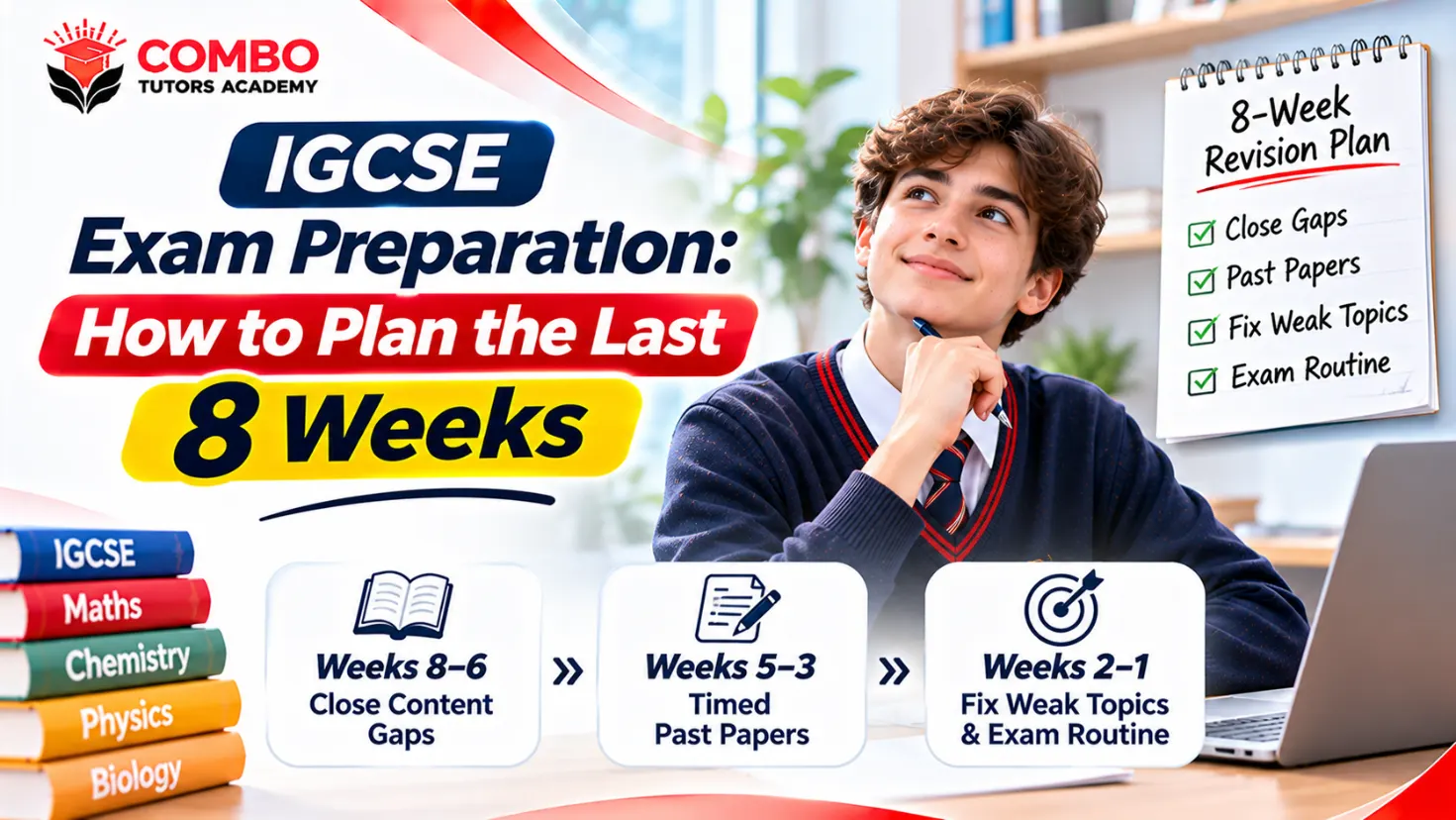
Table of Contents
**Updated: 20 November 2026 | By Combo Tutors Academy**
Eight weeks before your IGCSE exams, revision can start to feel overwhelming. There may be unfinished syllabus topics, disappointing mock results and several subjects competing for attention.
The solution is not to study every available hour. It is to follow a structured plan that prioritises weak topics, examination practice and consistent progress.
Whether you are preparing for Cambridge International IGCSE or Pearson Edexcel International GCSE examinations, the final eight weeks should have a clear purpose.
How Should You Prepare for IGCSE Exams in the Last 8 Weeks?
Divide your final eight weeks of IGCSE exam preparation into three phases: Weeks 8–6 for closing syllabus gaps, Weeks 5–3 for timed past-paper practice, and Weeks 2–1 for repairing weaknesses and establishing a reliable exam routine. Aim to finish major content revision by the end of Week 5, then prioritise examination questions, mark-scheme feedback and targeted revision.
The goal is to enter each examination knowing what you can do, which mistakes to avoid and how to manage your time.
The Three Phases of an Effective IGCSE Revision Plan
A successful revision plan should change as examinations approach. Repeating the same study routine for eight weeks can leave students with strong notes but insufficient examination practice.
Phase 1: Weeks 8–6 — Close Content Gaps
Start by identifying what you know and what you still struggle to understand.
Download the syllabus or specification for each subject from the relevant examination board. Cambridge International and Pearson Edexcel may assess similar topics differently, so always use the correct specification.
Create three categories:
- Green: Topics you can explain and answer independently.
- Amber: Topics you partly understand but regularly make mistakes in.
- Red: Topics you cannot confidently explain or solve.
Prioritise red topics, particularly those that support other parts of the syllabus.
For example, weak algebra skills can affect several IGCSE Mathematics topics, including equations, graphs and trigonometry.
In IGCSE Chemistry, misunderstanding moles can create difficulties with chemical calculations and reacting masses.
Use active recall, short topic-based questions and worked examples to rebuild understanding.
Target: Complete the main content-repair phase by the end of Week 5, while continuing to revisit difficult topics later.
Phase 2: Weeks 5–3 — Practise Timed Past Papers
Once most major content gaps have been addressed, shift the emphasis towards examination performance.
Students should practise questions under realistic time limits and become familiar with the structure of their examination papers.
Use the correct papers for your qualification, syllabus code, tier and examination route.
For example, Cambridge IGCSE Mathematics (0580) has different Core and Extended assessment routes. Pearson Edexcel International GCSE Mathematics A has its own specification and paper structure.
Students should not assume that papers from different boards are interchangeable.
During this phase:
- Complete timed examination sections or full papers.
- Mark answers using official mark schemes.
- Record every lost mark.
- Revisit topics responsible for repeated errors.
- Practise answering questions using the required terminology.
Target: Improve examination technique, accuracy and time management.
Phase 3: Weeks 2–1 — Repair Weaknesses and Establish an Exam Routine
The final two weeks are not the ideal time to start learning large amounts of unfamiliar content.
Instead, use evidence from previous practice to identify the highest-priority weaknesses.
Focus on:
- Frequently missed question types.
- Essential formulas and definitions.
- Repeated calculation mistakes.
- Examination command words.
- Questions that take too long.
- Topics that still cause confusion.
Continue practising, but avoid exhausting yourself with unnecessary full papers.
During the final days, prioritise sleep, organised materials and a predictable daily routine.
Target: Enter the examination prepared, rested and familiar with the expected question format.
Your Week-by-Week IGCSE Exam Preparation Plan
This eight-week timetable provides a practical starting point. Adjust it according to the student's subjects, school workload and actual examination dates.
Week 8 — Audit every subject. Review mock results, download the correct specifications, identify weak topics and create a realistic study timetable.
Week 7 — Repair foundational weaknesses. Focus on difficult concepts that affect multiple topics, such as algebra, scientific calculations or English comprehension.
Week 6 — Complete priority content revision. Continue topic-based practice, use active recall and begin incorporating short examination questions.
Week 5 — Finish major content gaps. Complete remaining high-priority syllabus revision and start regular timed past-paper sessions.
Week 4 — Strengthen examination technique. Practise full papers where appropriate, review mark schemes and identify recurring errors.
Week 3 — Improve timing and accuracy. Work under examination conditions, reduce repeated mistakes and practise difficult question types.
Week 2 — Target your weakest areas. Use your error log to select topics requiring attention and revisit essential formulas, definitions and techniques.
Week 1 — Consolidate and prepare. Review key concepts, complete manageable practice, organise examination materials and maintain a consistent sleep schedule.
Important: If one subject has an examination earlier than another, its preparation should move forward accordingly. Do not follow the timetable mechanically when actual examination dates require a different order.
How to Use IGCSE Past Papers Properly
Past papers are among the most useful revision resources, but completing them without reviewing mistakes limits their value.
The purpose of past-paper practice is to discover what you need to improve.
Step 1: Choose the Correct Paper
Use official papers matching your examination board and syllabus.
Check:
- Subject and specification code.
- Core or Extended tier, where applicable.
- Paper number and assessment format.
- Examination duration.
- Calculator requirements.
- Relevant syllabus changes.
For example, students following the revised Cambridge IGCSE Mathematics 0580 syllabus should practise the correct calculator and non-calculator paper formats.
For additional guidance, read our IGCSE Maths non-calculator revision guide.
Step 2: Complete the Paper Under Timed Conditions
Find a quiet space and remove unnecessary distractions.
Use only the materials permitted in the examination.
Set a timer based on the official paper duration.
If you are not ready for a complete paper, begin with a timed section and gradually progress towards full examinations.
Step 3: Mark Your Answers Using the Official Mark Scheme
Do not simply check whether the final answer is correct.
Study how marks are awarded.
In Mathematics, marks may be awarded for valid methods even when the final answer is incorrect.
In Science, explanations may require specific terminology or linked reasoning.
In English, the assessment criteria may focus on interpretation, organisation, language and supporting evidence.
Use examiner reports where available to understand common errors and the expectations of examiners.
Step 4: Record Every Lost Mark
Create a simple error log with four categories.
Knowledge error: You did not understand or remember the required concept.
Technique error: You understood the topic but did not answer the question in the required way.
Timing error: You ran out of time or spent too long on a particular question.
Careless error: You made an avoidable mistake, such as copying a number incorrectly or missing an instruction.
For example, suppose you lose six marks in a Chemistry paper:
- Three marks from misunderstanding mole calculations.
- Two marks from incomplete explanations.
- One mark from a calculation error.
Your next revision session should focus on mole calculations and scientific explanations, rather than repeating topics you already understand.
Step 5: Reattempt Incorrect Questions
After reviewing your mistakes, attempt the questions again without looking at the answers.
Then complete similar questions to check whether the improvement transfers to unfamiliar problems.
The best past-paper routine is: attempt, mark, diagnose, revise and reattempt.
How to Build a Weekly IGCSE Study Timetable
A realistic IGCSE study timetable should fit around school, homework, meals, family commitments and sleep.
Avoid creating a schedule that looks impressive but cannot be followed consistently.
Put School Commitments First
Start with fixed commitments such as school hours, homework deadlines and extracurricular activities.
Then identify realistic revision periods.
For many students, shorter focused sessions after school are more manageable than several uninterrupted hours.
Revise a Maximum of Two Main Subjects Per Day
A useful starting approach is to focus on one or two main subjects each day.
For example:
Monday: Mathematics and Chemistry.
Tuesday: English and Biology.
Wednesday: Physics and Mathematics.
Thursday: Chemistry and English.
Friday: Biology and Physics.
Saturday: Timed past-paper practice and error-log review.
Sunday: Rest or light revision when necessary.
This is an illustrative schedule, not a requirement. Students taking more subjects should rotate them across the week according to examination dates and learning needs.
Use Focused Study Blocks
A practical after-school session might include:
First 45 minutes: Revise one difficult topic.
10-minute break: Step away from the desk.
Next 45 minutes: Answer topic-based examination questions.
Final 15 minutes: Mark answers and update the error log.
Students should adjust session length according to their concentration and workload.
Protect a Rest Day
Regular breaks help make revision sustainable.
Reserve time each week for rest, physical activity and family life.
A student who follows a manageable timetable consistently is often better positioned than one who repeatedly attempts exhausting revision sessions.

Five IGCSE Revision Mistakes That Waste the Last 8 Weeks
1. Re-reading Notes Without Testing Understanding
Reading the same textbook pages repeatedly can create a feeling of familiarity without proving that the information can be recalled.
Better approach: Close the book and explain the topic from memory. Then answer examination questions.
2. Completing Every Question Without a Timer
Untimed practice helps with initial understanding, but students also need to perform within examination limits.
Better approach: Introduce timed sections and full papers as preparation progresses.
3. Ignoring Mark Schemes
Students may understand a topic but lose marks because their answers do not meet the assessment requirements.
Better approach: Review mark schemes and examiner guidance after practice.
4. Studying Late Into the Night
Sacrificing sleep for additional revision can undermine concentration and memory.
Better approach: Follow a consistent sleep routine and avoid last-minute overnight study sessions.
5. Starting Too Many New Resources
Switching between multiple textbooks, apps, revision guides and video courses can waste valuable time.
Better approach: Use the official syllabus, trusted learning materials and relevant past papers. Add another resource only when it addresses a specific learning problem.
What Parents Can Do During the Final 8 Weeks
Parents play an important role in creating an environment where students can revise consistently.
The goal is to support preparation without turning every conversation into a discussion about examination results.
Establish a Consistent Sleep Routine
Encourage regular bedtimes and sufficient sleep.
Avoid normalising late-night revision as evidence of hard work.
Agree on a Phone Routine
Work with your child to establish distraction-free study periods.
For example, phones can be kept away during focused revision sessions and used during planned breaks.
A predictable agreement is often more practical than repeatedly arguing about screen time.
Use Mock Results as Diagnostic Information
A disappointing mock result can identify weaknesses that still need attention.
Instead of focusing only on the grade, ask:
- Which topics caused the most difficulty?
- Were marks lost because of knowledge or examination technique?
- Did the student finish the paper?
- What should change in the next revision session?
Mock examinations are useful because they reveal problems before the final assessment.
Review Progress Weekly
A short weekly discussion can help students stay organised.
Ask what improved, which topics remain difficult and whether the timetable needs adjustment.
Avoid comparing the student's progress with siblings or classmates.
When Should You Consider an IGCSE Exam Preparation Tutor?
Some students can manage the final eight weeks independently.
Others benefit from additional support when they repeatedly struggle with the same concepts or cannot identify why they are losing marks.
A tutor may be useful when:
- Mock results reveal persistent subject weaknesses.
- The student does not understand key syllabus topics.
- Past-paper mistakes keep recurring.
- Revision lacks structure.
- The student needs help interpreting mark schemes.
- Examination anxiety is affecting preparation.
Effective tutoring should target specific learning gaps rather than repeat everything already taught in school.
Get Your 8-Week Revision Plan Checked
Combo Tutors Academy offers personalised online support for Cambridge and Edexcel IGCSE students.
Our IGCSE exam preparation tutors can help students identify difficult topics, practise examination questions and build a structured revision routine.
Book a free 30-minute trial lesson to discuss your child's subjects, examination timetable and current preparation.
Frequently Asked Questions About IGCSE Exam Preparation
How many hours a day should I revise for IGCSE exams?
There is no fixed number of hours suitable for every student. During school weeks, one to two hours of focused independent revision may be a practical starting point, depending on homework and other commitments. Students should prioritise quality, regular breaks and sufficient sleep over excessive study hours.
When should I start doing IGCSE past papers?
Begin using topic-based past-paper questions as soon as you understand the relevant content. During the final eight weeks, introduce timed practice progressively, with more emphasis on complete papers during Weeks 5–3. Do not wait until every topic is perfect before attempting examination questions.
Is eight weeks enough to improve an IGCSE grade?
Eight weeks can provide meaningful time to address weaknesses and improve examination performance, especially with a structured revision plan. However, improvement depends on the student's starting level, subjects, consistency and learning needs. No particular grade increase can be guaranteed.
How many subjects should I revise per day?
One or two main subjects per day is a manageable starting point for many students. Rotate subjects throughout the week and prioritise those with earlier examination dates or significant learning gaps.
Should I make revision notes or practise questions?
Use both, but avoid spending most of the final eight weeks rewriting notes. Brief summaries can help with difficult concepts, while active recall and examination questions reveal whether you can apply what you have learned.
What should I do if I am behind on IGCSE syllabus content?
Start by identifying the most important missing topics. Prioritise foundational concepts, upcoming examination requirements and areas that repeatedly cause mistakes. Use short explanations followed by targeted questions. If the gaps are extensive, consider structured support from a subject tutor or teacher.
Final Thoughts: Make the Last 8 Weeks Count
Effective IGCSE exam preparation is not about studying for the longest possible time.
It is about identifying weaknesses, practising under examination conditions and using feedback to improve.
Use the first phase to repair content gaps, the middle phase to strengthen past-paper performance and the final phase to consolidate learning and prepare for examination day.
Keep your timetable realistic, review your progress and protect your sleep.
Need help building a personalised revision plan? Explore one-to-one IGCSE tutoring with Combo Tutors Academy and book a free 30-minute trial lesson.
- Free 30-minute trial
- Tutor matched to your exam board
- Live one-to-one online lessons